

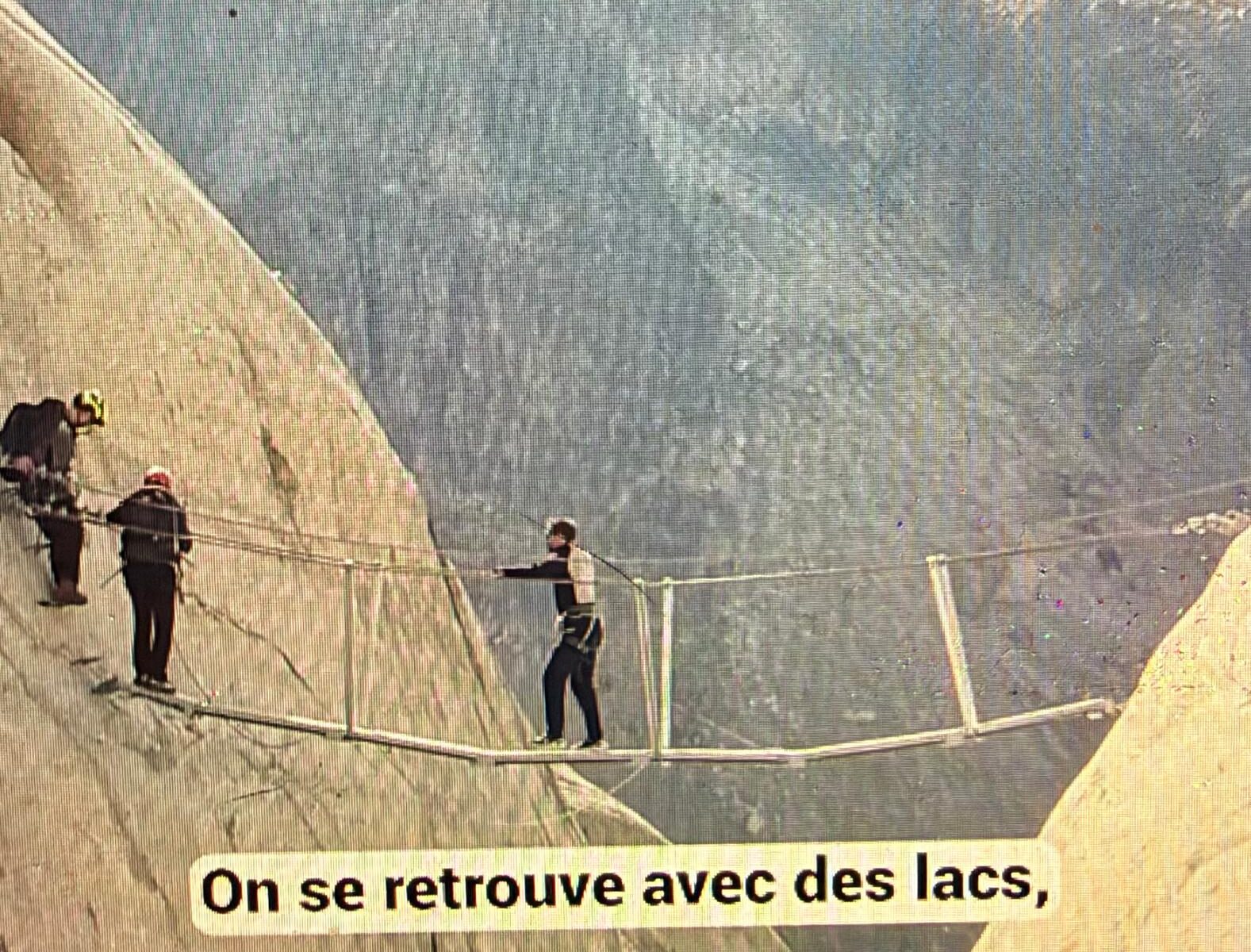
Three Himalayan-style suspension bridges above the Mer de Glace highlight how glacier retreat is forcing Chamonix to rethink mountain access, hiking routes and the infrastructure needed to keep the high Alps accessible.
For generations, glaciers provided natural passages through the Alps. Today, in some places, their retreat is leaving behind steep rock faces, unstable terrain and deep gaps that require entirely new solutions.
Above Chamonix’s famous Mer de Glace, three suspension bridges now illustrate this transformation particularly vividly.
The structures, described as Himalayan-style footbridges, allow mountaineers and experienced hikers to cross sections of the Balcons de la Mer de Glace where the changing landscape has made traditional routes increasingly difficult.
French regional newspaper Le Dauphiné Libéré reported on the bridges on 13 October 2026, followed by a video report on 14 October showing local officials inspecting the installations.
The story goes well beyond an unusual feat of mountain engineering. It raises a much broader question: how much infrastructure will Alpine destinations need to build simply to maintain access to places that were once naturally connected by ice?
Three Suspension Bridges Above the Mer de Glace
The three footbridges cross gaps in the high-mountain landscape above the Mer de Glace, one of the best-known glaciers in the French Alps.
According to Le Dauphiné Libéré, the installations were inspected by local officials and technical teams, including Stéphane Bozon, Chamonix’s deputy mayor responsible for mountain safety, and Arnaud Guyon, a senior representative of the Chamonix Valley intercommunal authority.
The newspaper describes a narrow suspended crossing above a canyon with a torrent flowing below.
While the bridges provide impressive views of the surrounding mountains, their primary purpose is practical: maintaining passage across terrain transformed by glacial retreat.
They are not simply a new tourist attraction. They are part of the continuing challenge of keeping high-altitude routes usable as the mountain landscape changes.
When Retreating Glaciers Change the Routes
The Mer de Glace has long been central to Chamonix’s mountaineering heritage.
But as glaciers lose thickness and retreat, routes that previously relied on ice can become considerably more complicated.
Rock walls once bordered by ice become exposed. Moraines can become unstable. New gullies and watercourses can appear, while existing approaches to mountain refuges may become more difficult or hazardous.
This is particularly significant around the Refuge du Couvercle, at approximately 2,687 metres, which provides access to some of the Mont Blanc massif’s most spectacular mountaineering terrain, including the Grandes Jorasses.
The refuge’s own access information documents how routes have evolved.
The former Égralets ladder route was dismantled in September 2025, leaving access via a newer itinerary shared with the Refuge de la Charpoua.
That route incorporates ladders, equipped sections and exposed passages above the Mer de Glace.
The changing access arrangements illustrate an important reality: glacier retreat does not simply increase the distance between visitors and the ice. It can fundamentally change how people move through the mountains.
Chamonix Has Been Adapting Its Infrastructure for Years
The new suspension bridges are part of a much longer process of adaptation.
Chamonix has already invested in changes to the Montenvers–Mer de Glace visitor infrastructure.
A new gondola providing access towards the glacier entered service in February 2024, replacing the previous installation as part of a wider redevelopment programme.
The project also includes improvements to visitor circulation and plans for the Glaciorium, a centre dedicated to understanding glaciers and climate.
These developments address different aspects of the same challenge.
At Montenvers, the priority includes maintaining visitor access and explaining the changing glacier environment.
Higher in the mountains, the priority is keeping mountaineering routes and refuge approaches viable and as safe as reasonably possible.
The infrastructure requirements are different, but the underlying pressure is shared.
The Growing Cost of Keeping Mountain Routes Open
There is also an economic dimension to glacier retreat that receives less attention than the environmental consequences.
Mountain communities increasingly need to maintain or replace infrastructure as terrain changes.
This can involve relocating trails, installing ladders, reinforcing exposed passages, constructing bridges and reassessing access routes.
A Chamonix municipal publication from 2019 had already identified changing access to mountain refuges as a major adaptation issue.
It named several affected refuges, including the Couvercle, Requin, Leschaux, Envers des Aiguilles and Argentière.
At that time, the municipality reported average annual expenditure of approximately €83,000 for high-altitude trail and access interventions undertaken by its paths and trails service.
That historical figure is not the cost of the three new bridges, which has not been independently confirmed.
Nevertheless, it demonstrates that maintaining mountain access in a changing environment has been an ongoing financial responsibility for years.
What Does This Mean for Alpine Tourism?
For visitors, the implications extend beyond mountaineering.
The Alps depend on a network of trails, mountain refuges, cable cars, viewpoints and access routes that connect visitors with high-altitude landscapes.
Some are designed for casual sightseeing. Others serve experienced hikers, climbers and mountain professionals.
As glaciers retreat, maintaining these connections can require increasingly complex engineering and continued investment.
The Chamonix bridges are a striking example of adaptation rather than abandonment.
Instead of closing access entirely, local authorities are finding ways to preserve routes where conditions allow.
However, new infrastructure does not eliminate the risks associated with high-mountain travel.
The Balcons de la Mer de Glace and approaches to the Refuge du Couvercle remain demanding mountain itineraries involving exposed terrain, ladders and, depending on the route, glacier travel.
They should not be confused with ordinary sightseeing paths accessible from the Montenvers railway.
Visitors should consult current route information, assess their experience and equipment, and consider using a qualified mountain guide.
A Different Future for the Alps
Glacier retreat is often illustrated through photographs comparing the same landscape decades apart.
The Chamonix suspension bridges offer another perspective.
They show what happens after the ice disappears and mountain communities must decide how to maintain access across the terrain left behind.
In this case, the response has been to build three suspended crossings above the Mer de Glace.
It is a remarkable example of Alpine engineering, but also a visible reminder of how rapidly the relationship between people and the mountain environment is changing.
Where ice once helped shape the route, bridges now help keep it open.
And as Alpine glaciers continue to retreat, similar decisions about access, safety, investment and adaptation are likely to become increasingly important across the mountain tourism industry.
Read More on The-Ski-Guru
Glacier Retreat, Climate Change & Mountain Infrastructure
Mer de Glace Ice Cave Celebrates 80 Years as the Glacier Continues to Retreat
Chamonix Invests in Snowmaking at La Flégère — But for How Long?
Mountain Safety & Access
Discover Chamonix
Sources and Further Reading
- Le Dauphiné Libéré – Suspension Bridges Above the Mer de Glace, 13 October 2026
- Le Dauphiné Libéré – Video Report, 14 October 2026
- Refuge du Couvercle – Official Access Information
- Refuge du Couvercle – Changes to Summer Access Routes
- Mont Blanc Natural Resort – Montenvers Redevelopment Project

Planning your next trip to the Italian Alps?
If you’re heading to the Aosta Valley, take a look at Il Cuore della Valdigne, our family-owned apartment in Morgex, available for rent when we’re not using it ourselves.
It’s an ideal base to:
- Ski in Courmayeur, La Thuile and Pila
- Enjoy the mountains in summer (hiking, biking, nature)
- Explore the Mont Blanc valley in a quieter, more authentic setting.
Check my Mountain Art on my Shop
You can go to my shop and see what have been inspiring me lately, lots mountain landscapes in soft pastels, and now in oils too. Go here to check my latest works!
Featured Image: Hanging Bridge in Chamonix’s Mer de Glace. Screenshot of FB post of Le Dauphiné Libéré


Discover more from The-Ski-Guru
Subscribe to get the latest posts sent to your email.
 Subscribe to The-Ski-Guru here.
You must be logged in to post a comment.