Valais authorities have rejected an appeal by the operators of the historic Rhône Glacier ice cave, ordering an end to the tourist operation and the restoration of a nationally protected Alpine site. A further court appeal remains possible.
One of Switzerland’s best-known glacier attractions is facing closure after the Valais cantonal government rejected an appeal by its operators.
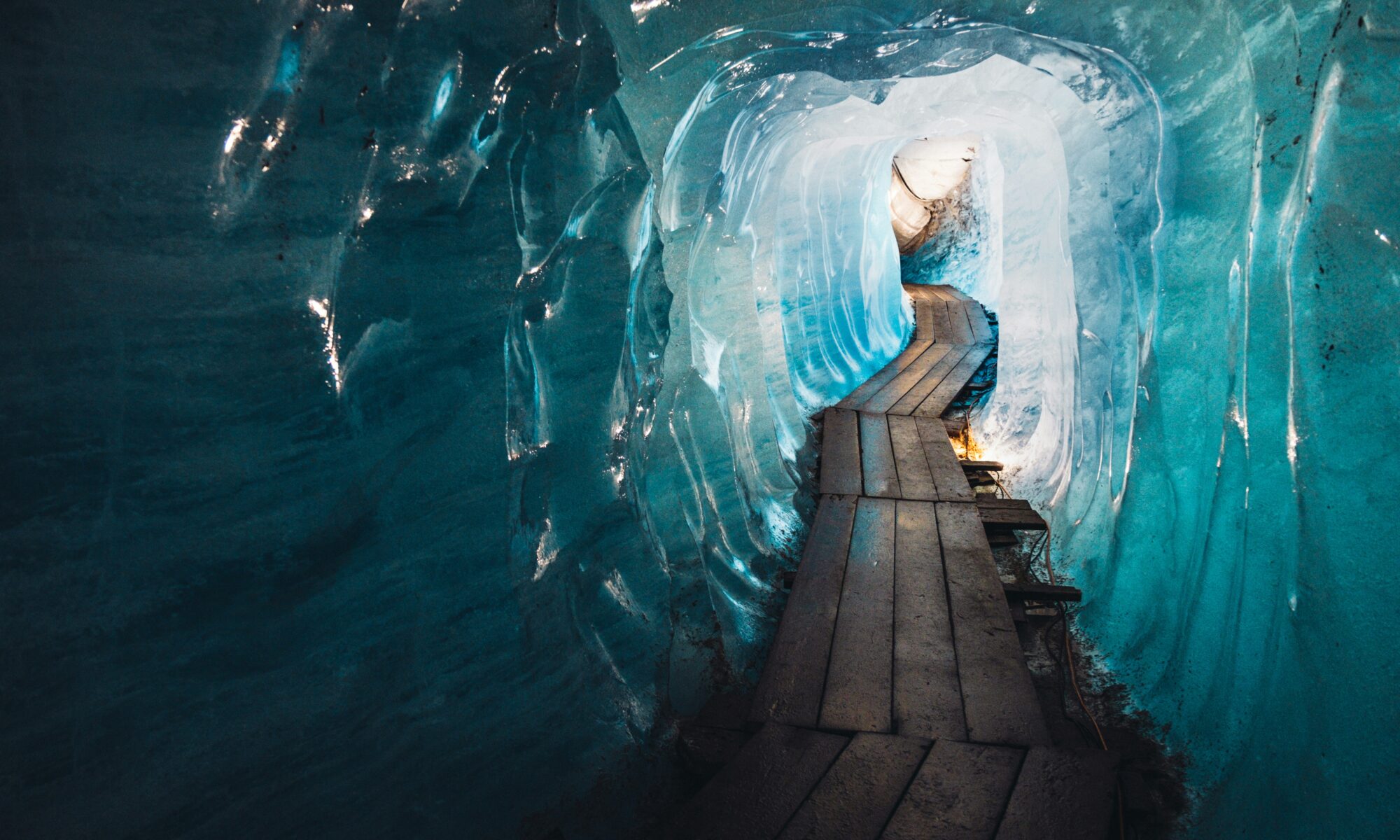
The decision concerns the ice grotto carved into the Rhône Glacier near the Furka Pass, an attraction reportedly visited by around 100,000 people each year.
The authorities have ordered the site to be restored and tourist operations to cease, concluding that both the excavated tunnel and the protective coverings placed over the ice should have received prior authorisation.
The Planpincieux hanging glacier above Val Ferret near Courmayeur in the Mont Blanc massif raised alarm among scientists after monitoring systems detected accelerated movement in the ice mass.
Experts warned that a section of ice estimated at around 8.8 million cubic feet could potentially detach from the glacier, which sits on steep slopes overlooking the valley.
UPDATE — August 2026:Nepal Glacier Disaster: Could It Happen in the Alps? — Seven years after this article was published, Planpincieux remains under close surveillance. Following the catastrophic glacier-related disaster in Nepal, we examine how monitoring has evolved in the Alps and what happens when a mountain failure develops too quickly for conventional warning systems.
The Planpincieux hanging glacier on the Mont Blanc massif has remained under close observation in recent years due to the risk of large ice blocks detaching from the slope above Val Ferret near Courmayeur.
Authorities monitor the glacier using radar systems, satellite measurements and ground sensors that track the movement of the ice mass. During periods when the glacier accelerates, precautionary evacuations have been ordered in parts of Val Ferret as a safety measure.
Monitoring unstable mountain slopes has become increasingly common across the Alps.
A helicopter rides on top of the glacier. Photo: Antonio Calanni AP – The Guardian. A fast-melting glacier in the Mont Blanc raised an alarm in the area of Val Ferret of Courmayeur.
The Planpincieux glacier is a hanging glacier, meaning a large mass of ice resting on steep rock slopes that can break off suddenly when fractures develop or temperatures rise.
The glacier overlooks the Val Ferret and Planpincieux, 7 km up from Courmayeur. Experts from Fondazione Montagna Sicura (Safe Mountain Foundation), a charity in charge of monitoring the glaciers of Aosta Valley, said that this glacier has been moving since they have been monitoring it closely starting in 2013, but the size of a recent fracture and the increase of the speed at which the ice is melting raised the alarm.
This area is popular with hikers, so Courmayeur’s Major Miserocchi closed as a safety measure, mountain refuges and part of a road upon which the ice could directly fall. Contrary to first reported, only one home had to be evacuated. The rest of the 10 homes in the hamlet beneath the glacier are empty summer holiday homes.
Chacaltaya Ski Resort is not Operating due to the Retreat of a 18,000-year-old glacier.
Chacaltaya, the world’s highest ski resort in Bolivia, has been deserted after its 18,000-year-old glacier has melted away.
The Chacaltaya Ski Resort was once the only ski resort in Bolivia, where people of the neighbouring La Paz used to go skiing. The resort was also the home of the highest restaurant in the world and the resort itself was also the highest ski resort in the world. As the glacier melted, the resort was abandoned.
Chacaltaya Ski Resort in Bolivia. Chacaltaya Ski Resort is not Operating due to the Retreat of a 18,000-year-old glacier.
The resort opened in the late 1930s and the season used to last between seven or eight months per year. Visitors came to ski and sledge down the Chacaltaya Glacier until the cold and the altitude made them return to lower elevations.
At 17,519 feet (5,340 m) above sea level, Chacaltaya Ski Resort was not for the heart fainted! The altitude is higher than the North Base Camp of Mount Everest. The restaurant is still recognised as the highest mountain in the world by the Guinness Records.
What does Climate Change will mean to a Mountain Nation such as Switzerland by 2060. From Swissinfo.ch – Climate Change in forty years in Switzerland will mean over 40C in the cities, long droughts and not too much snow in winter, Switzerland will be looking as a Mediterranean country. This will have consequences in this land-lock country.
Verbier – Valais – What does Climate Change will mean to a Mountain Nation such as Switzerland by 2060.
By 2060 the typical weather forecast on a summer day can describe 45C in the cities and twenty days of sustained heat. MeteoSwiss (the federal department of meteorology and climatology) has devised different climate scenarios for Switzerland, in conjunction with the Federal Institute of Technology in Zurich (ETHZ) and publish edit in a report in mid-November. Peter Binder, the head of MeteoSwiss summarised that “Switzerland will be a hotter and drier place”.
Enjoyed this post? Get my latest ski guides, weather insights, resort updates and travel tips directly in your inbox. Subscribe to The-Ski-Guru here.
Manage Cookie Consent
To provide the best experiences, we use technologies like cookies to store and/or access device information. Consenting to these technologies will allow us to process data such as browsing behavior or unique IDs on this site. Not consenting or withdrawing consent, may adversely affect certain features and functions.
Functional
Always active
The technical storage or access is strictly necessary for the legitimate purpose of enabling the use of a specific service explicitly requested by the subscriber or user, or for the sole purpose of carrying out the transmission of a communication over an electronic communications network.
Preferences
The technical storage or access is necessary for the legitimate purpose of storing preferences that are not requested by the subscriber or user.
Statistics
The technical storage or access that is used exclusively for statistical purposes.The technical storage or access that is used exclusively for anonymous statistical purposes. Without a subpoena, voluntary compliance on the part of your Internet Service Provider, or additional records from a third party, information stored or retrieved for this purpose alone cannot usually be used to identify you.
Marketing
The technical storage or access is required to create user profiles to send advertising, or to track the user on a website or across several websites for similar marketing purposes.




 Subscribe to The-Ski-Guru here.
You must be logged in to post a comment.