Mont Blanc Is Growing Again — But What Does Its New Height Really Tell Us?

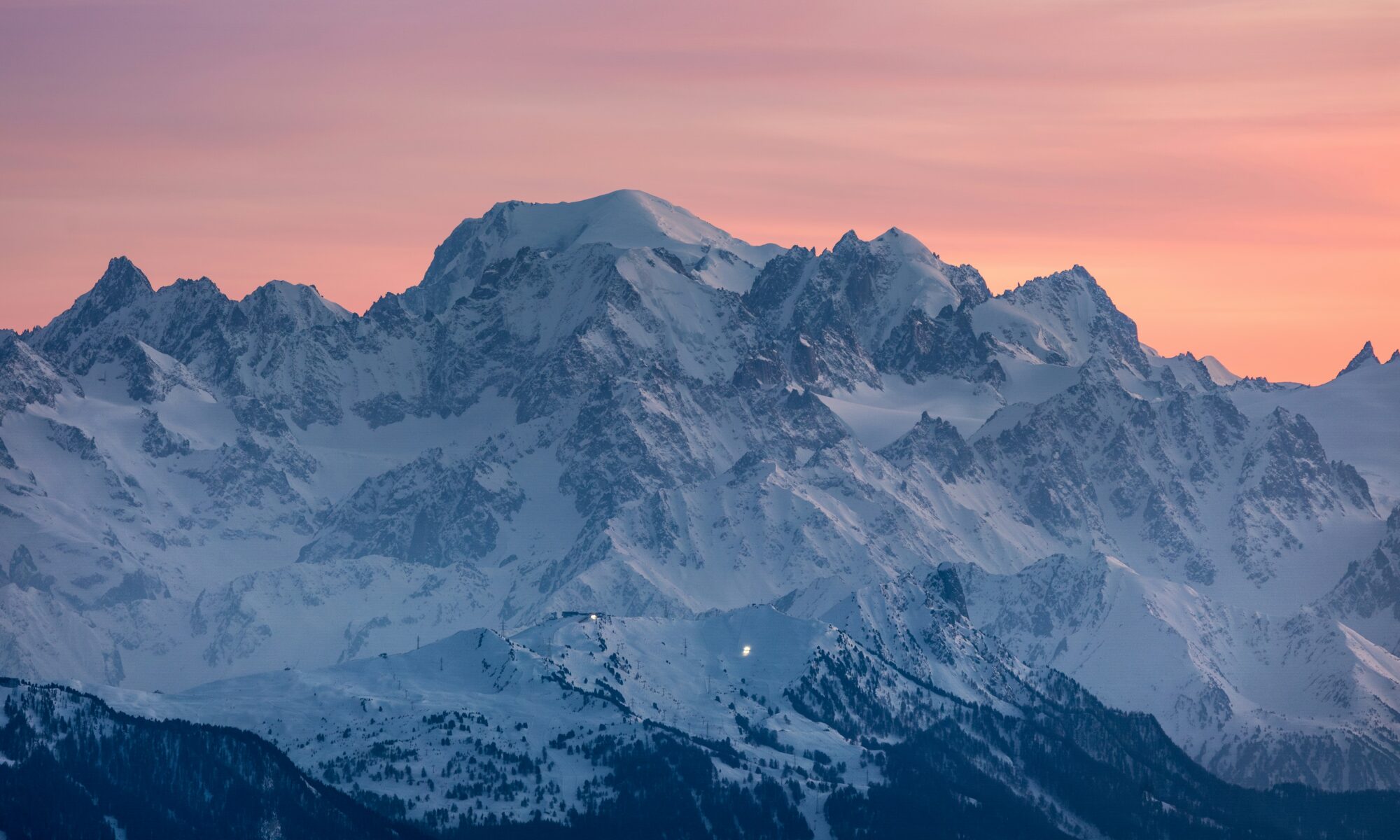
Mont Blanc seen from the French side. Photo credit: Marek Piwnicki. Unsplash.

Europe’s highest Alpine summit has gained nearly two metres since 2023, but scientists warn that changes in its snowy peak should not be confused with the wider retreat of Alpine glaciers.

Mont Blanc, the highest mountain in the Alps and Western Europe, has a newly confirmed altitude: 4,807.47 metres above sea level.

The figure was officially announced on 14 October 2026 following a French scientific expedition to the summit in September.

The measurement represents an increase of 1.88 metres compared with 2023, when Mont Blanc stood at 4,805.59 metres.

However, there is an interesting twist: the mountain is actually 1.29 metres lower than it was in 2025.

So, is Mont Blanc growing or shrinking? And what does this tell us about climate change in the Alps?

Continue reading “Mont Blanc Is Growing Again — But What Does Its New Height Really Tell Us?”

Where There Was Once Ice, Suspension Bridges Now Span the Gaps Above Chamonix’s Mer de Glace

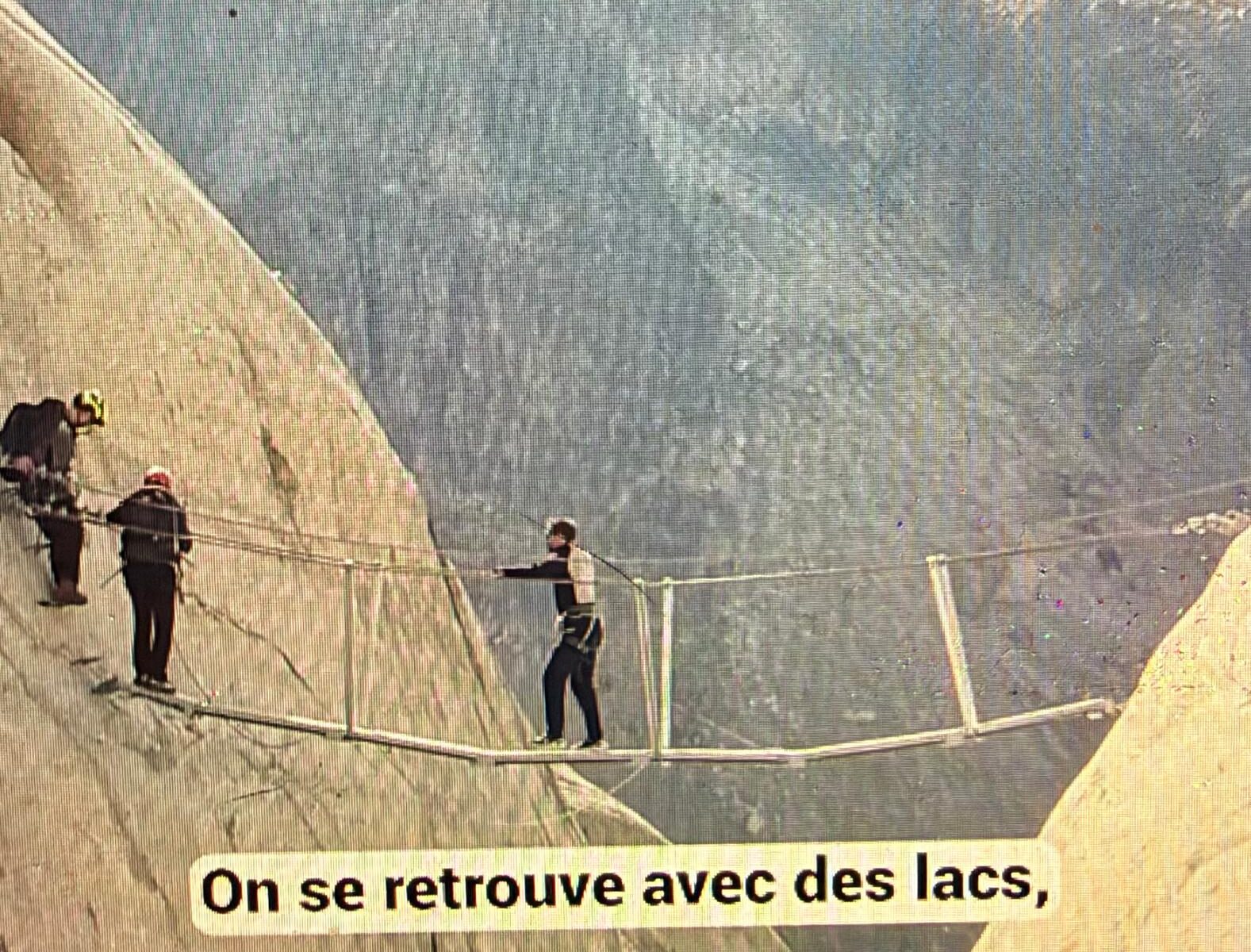
Hanging Bridge in Chamonix's Mer de Glace. Screenshot of FB post of Le Dauphiné Libéré

Three Himalayan-style suspension bridges above the Mer de Glace highlight how glacier retreat is forcing Chamonix to rethink mountain access, hiking routes and the infrastructure needed to keep the high Alps accessible.

For generations, glaciers provided natural passages through the Alps. Today, in some places, their retreat is leaving behind steep rock faces, unstable terrain and deep gaps that require entirely new solutions.

Above Chamonix’s famous Mer de Glace, three suspension bridges now illustrate this transformation particularly vividly.

The structures, described as Himalayan-style footbridges, allow mountaineers and experienced hikers to cross sections of the Balcons de la Mer de Glace where the changing landscape has made traditional routes increasingly difficult.

French regional newspaper Le Dauphiné Libéré reported on the bridges on 13 October 2026, followed by a video report on 14 October showing local officials inspecting the installations.

Continue reading “Where There Was Once Ice, Suspension Bridges Now Span the Gaps Above Chamonix’s Mer de Glace”

Matterhorn Without Snow: Hervé Barmasse Warns of a Changing Mountain

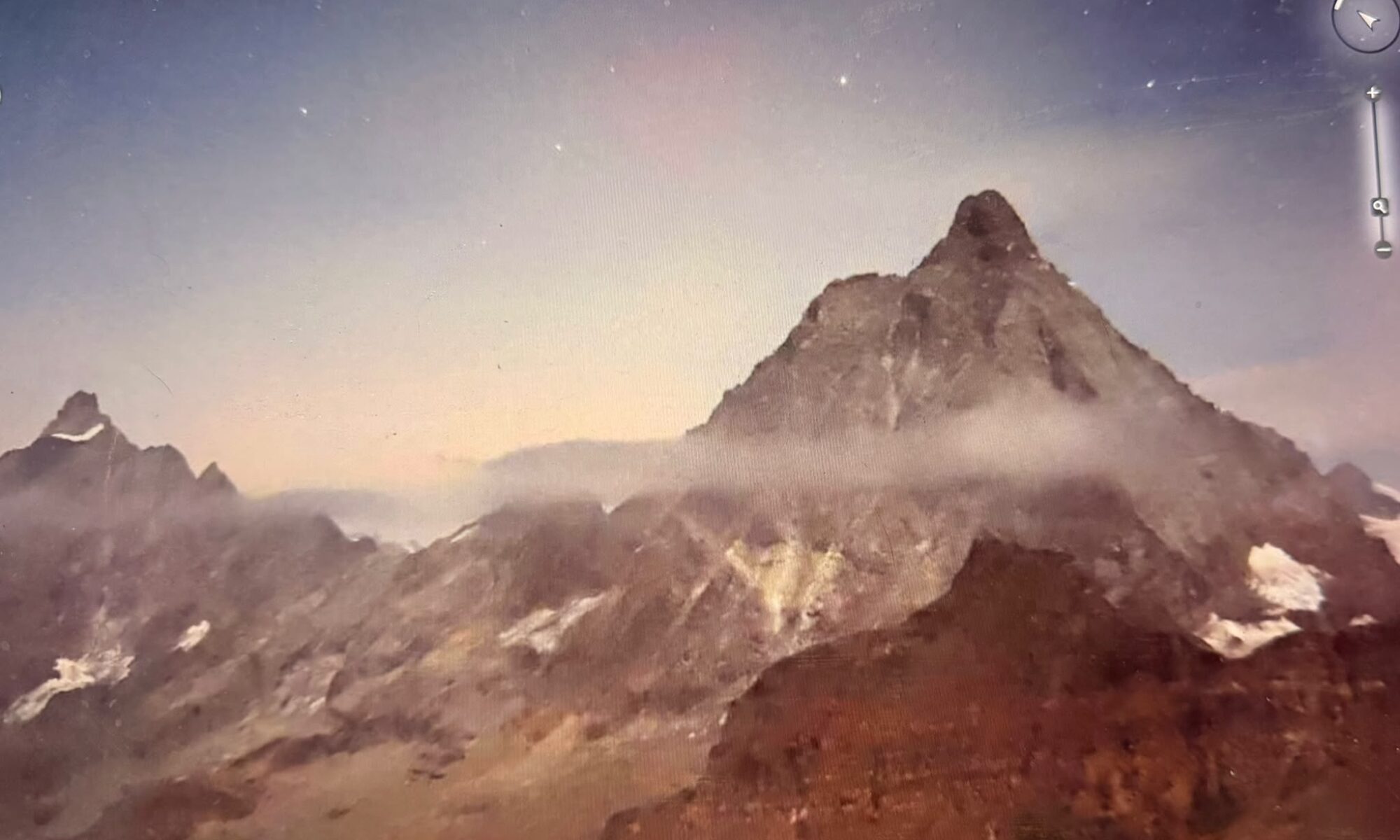
The Cervino, as seen on the early morning of 3rd October 2026. Photo: Webcam Cervino Ski Paradise.

The Matterhorn has appeared almost completely bare at the end of the 2026 summer season. For Italian alpinist and mountain guide Hervé Barmasse, who has spent his life beneath the mountain, the striking images are part of a much bigger change taking place at high altitude.

Only days after a new rockfall prompted the Cervino mountain guides to advise against climbing the Italian normal route, one of the mountain’s best-known alpinists has spoken about another striking feature of the Matterhorn in 2026: the lack of snow.

Hervé Barmasse, a fourth-generation mountain guide from Valtournenche, told Italian mountain publication L’AltraMontagna that he had never seen the Cervino — as the Matterhorn is known in Italy — quite so bare.

His comments are particularly significant because this is not a mountain he encounters occasionally.

Continue reading “Matterhorn Without Snow: Hervé Barmasse Warns of a Changing Mountain”

Record-Breaking El Niño Is Here — What Could It Mean for Europe’s 2026/27 Ski Winter?

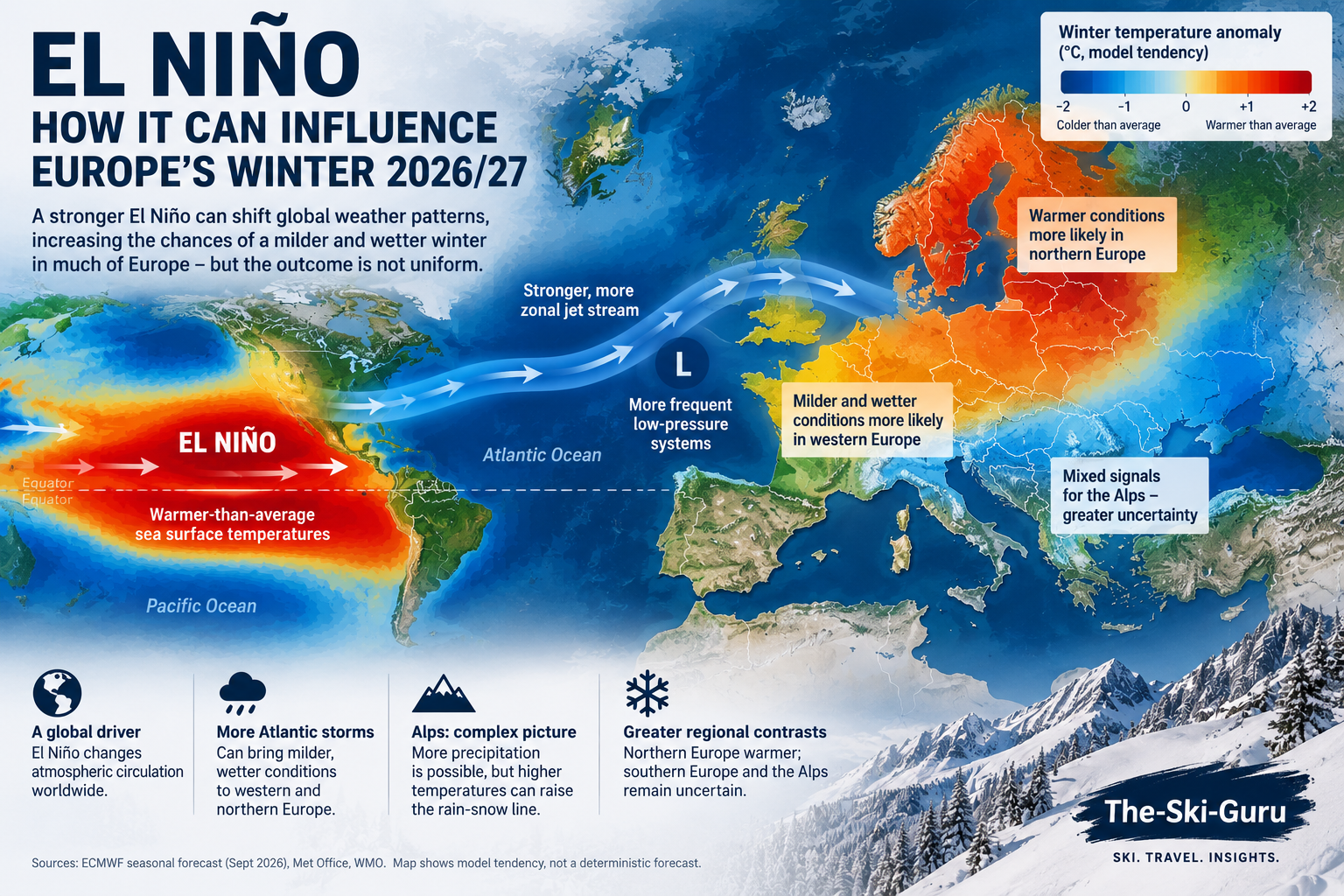
Illustration of how El Niño can influence European winter weather patterns. The impact on the Alps remains complex, with temperature, precipitation and storm tracks determining whether moisture falls as rain or snow. AI-generated illustration created for The-Ski-Guru. Not an official meteorological forecast map.

El Niño could influence Europe’s winter 2026/27. A record-breaking El Niño is building towards its winter peak, but despite dramatic headlines, it does not automatically mean a snowy — or snowless — winter for the Alps. Here is what the official forecasts actually tell us.

El Niño has officially entered record territory. When we first looked at what El Niño could mean for the 2026/27 ski season in August, the event was still developing. Since then, the signal has strengthened considerably.

On 22 September, the UK Met Office confirmed that sea-surface temperatures in the central equatorial Pacific have now surpassed those recorded during previous El Niño events, making the developing 2026 event the strongest in the observational record.

It is an extraordinary climate signal — and one arriving just as the Northern Hemisphere ski industry prepares for winter 2026/27.

But does a record El Niño mean a record ski season?

Not necessarily.

For Europe in particular, the relationship between El Niño and Alpine snowfall is considerably more complicated than some of the increasingly dramatic seasonal forecasts circulating online might suggest. Continue reading “Record-Breaking El Niño Is Here — What Could It Mean for Europe’s 2026/27 Ski Winter?”

Switzerland Won’t Run Out of Water When Its Glaciers Disappear — But Summer Is Another Story

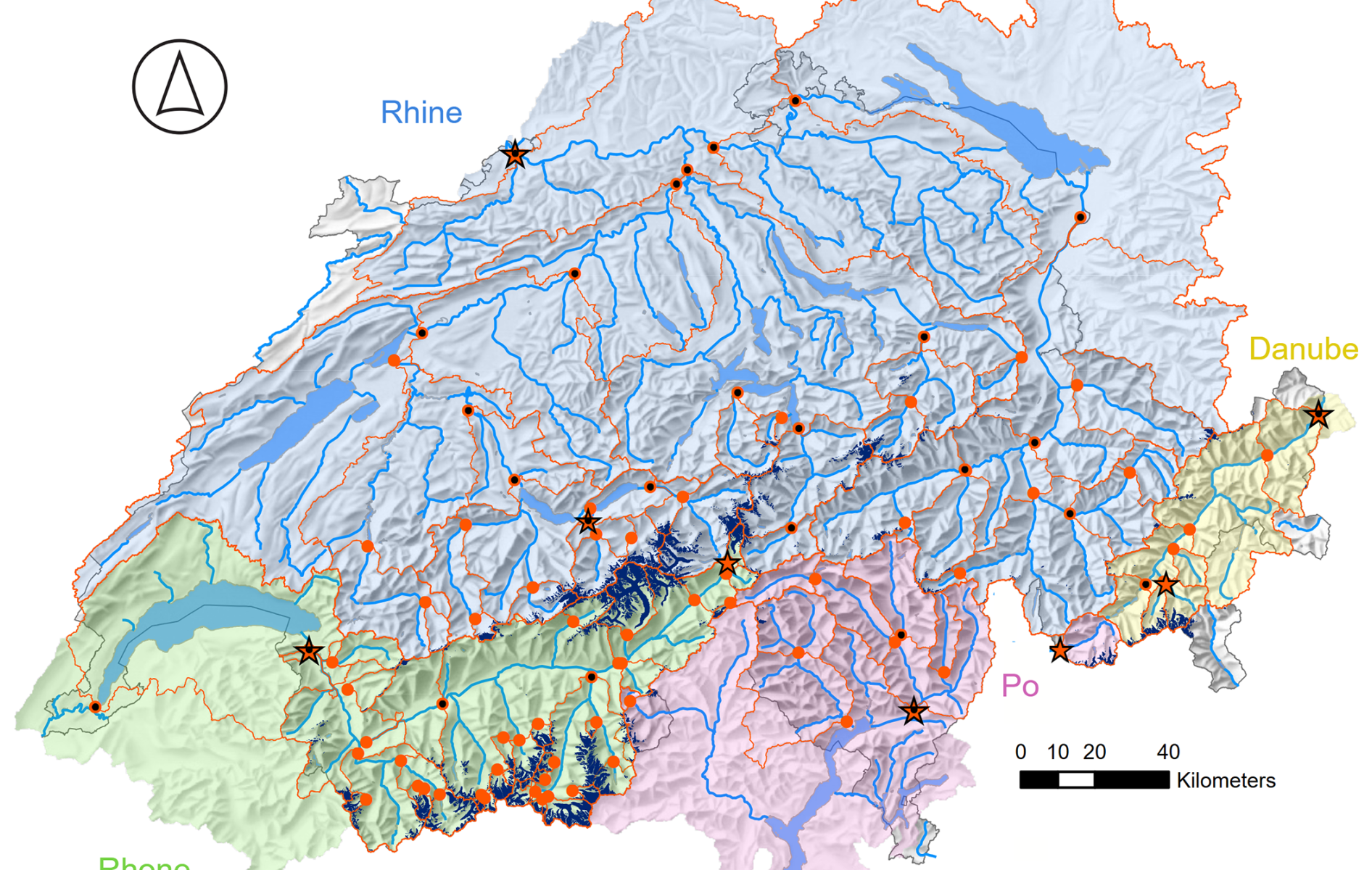
Map of hydrological Switzerland. Credit: Hess Copernicus.

Switzerland’s glaciers are shrinking rapidly, but their disappearance does not mean the country will simply run out of water. The bigger problem is when that water will be available — particularly during increasingly hot and dry Alpine summers.

Switzerland is often described as the “water tower of Europe”, while its rapidly retreating glaciers have become one of the most visible symbols of climate change in the Alps.

It is therefore easy to make a seemingly obvious connection: if the glaciers disappear, Switzerland will lose a major source of its water.

The reality is more complicated.

Swiss hydrologist Bettina Schaefli, professor at the University of Bern, recently challenged that assumption in an opinion piece published by Le Temps, arguing that Switzerland does not owe its abundant water resources primarily to its glaciers.

She is right — at least when looking at the country’s overall annual water balance.

Switzerland’s real hydrological advantage is the Alps themselves. The mountain barrier forces moist air upwards, producing substantial precipitation as rain and snow.

But that does not mean disappearing glaciers are irrelevant to Switzerland’s water supply.

Far from it.

What Switzerland is gradually losing is something particularly valuable: a natural water reserve capable of releasing water precisely when rainfall and snowmelt are no longer providing enough of it.

And during a drought, that distinction becomes crucial.

Continue reading “Switzerland Won’t Run Out of Water When Its Glaciers Disappear — But Summer Is Another Story”

Nepal’s Glacier Disaster Is a Warning for Mountain Regions Everywhere — Including the Alps

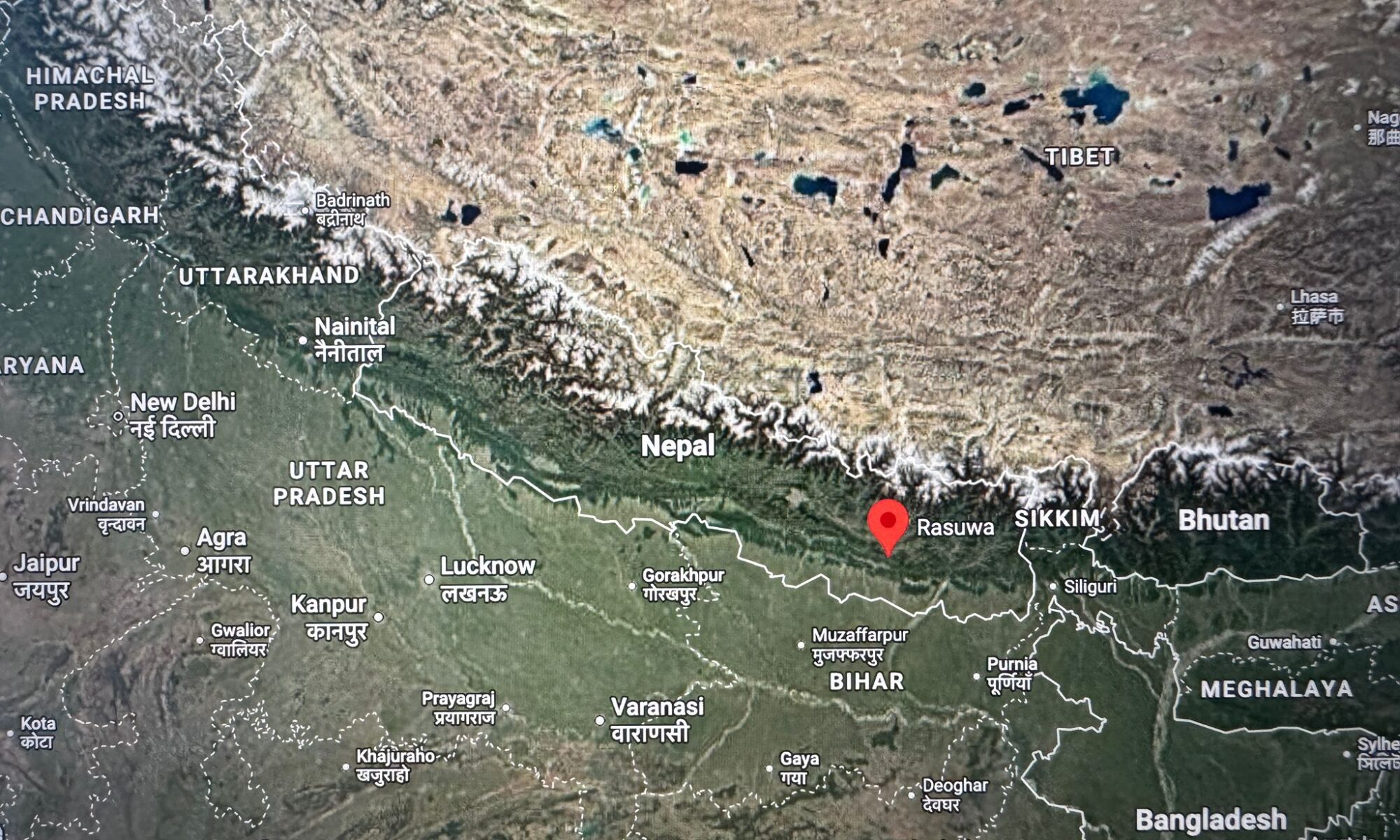
Map of Rasuwa in Nepal, where the floodings occurred. Photo: Google Maps.

A catastrophic glacier-related collapse in the Himalayas has killed hundreds of people across Nepal and Tibet and left many more missing.

But beyond the shocking images and the rapidly evolving casualty figures lies a much bigger question for mountain regions around the world:

Could something similar happen in the Alps?

The answer is uncomfortable.

The precise sequence that produced the Nepal disaster is still being investigated. But glacier collapses, rock avalanches, sudden releases of glacial water, debris flows and naturally dammed lakes are not unique to the Himalayas. They are hazards that also exist in the Alps — and Alpine history provides some dramatic examples.

What can be very different is the ability to identify certain dangers in advance, monitor them and evacuate people before the mountain moves.

And even in the best-monitored Alpine countries, that warning cannot always be guaranteed.

Continue reading “Nepal’s Glacier Disaster Is a Warning for Mountain Regions Everywhere — Including the Alps”

Randa Raises Alert Level as Weisshorn Hanging Glacier Accelerates Above Zermatt Valley

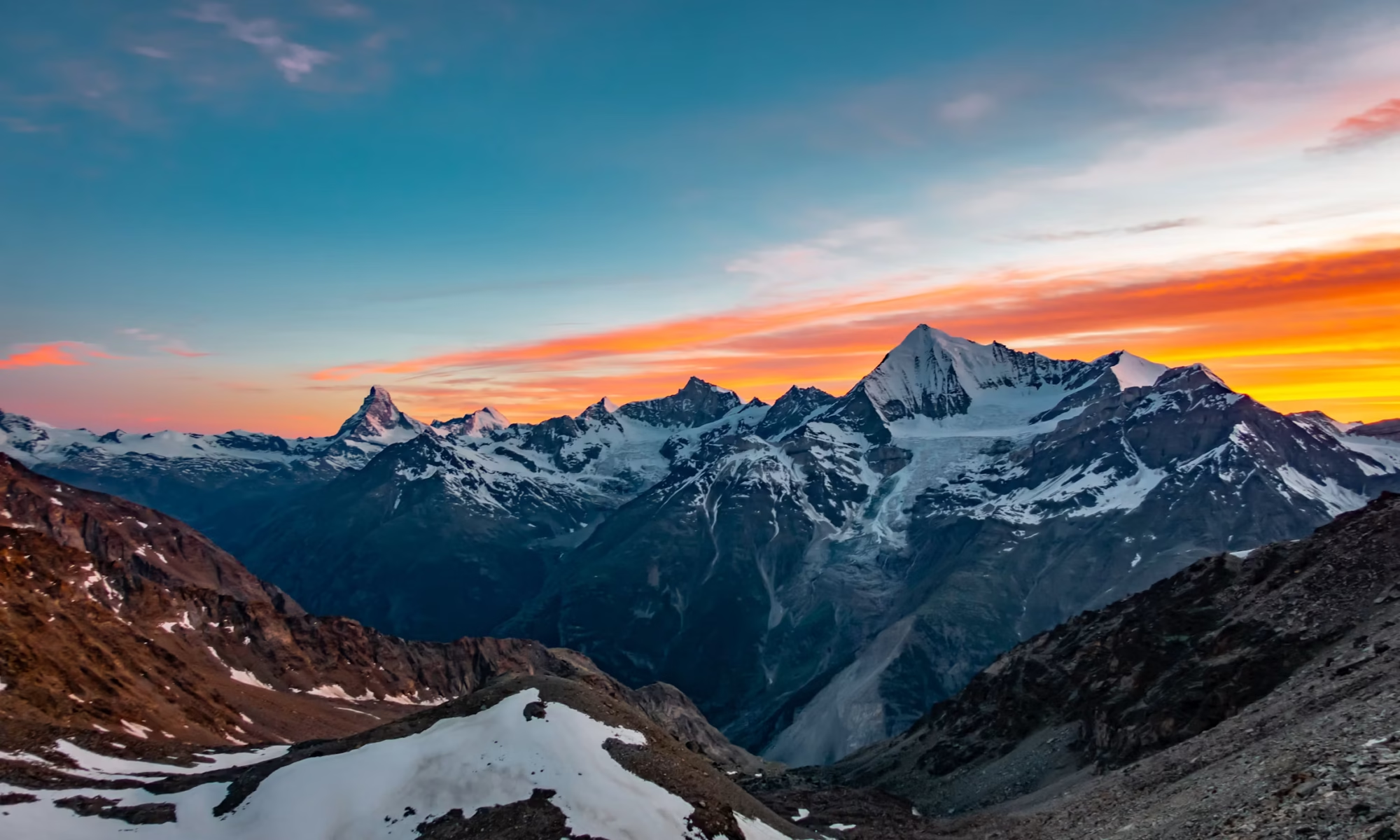
Sunset over the Matterhorn and Weisshorn, from Nadelgrat, Randa. Photo by: Sylvain Maroux. Unsplash.

Authorities in the Swiss canton of Valais have increased monitoring of the Weisshorn East hanging glacier above Randa to Level 3, following a marked acceleration in its movement and several ice break-offs.

Randa lies in the Mattertal, on the main valley approach towards Täsch and Zermatt, making the situation particularly relevant for visitors travelling through the region.

The municipality said movements of the hanging glacier have been monitored more closely since the end of June 2026. Following a significant increase in movement and acceleration, monitoring was raised to Level 3 on 24 August.

At least three break-offs occurred during the afternoon of 24 August, with the largest taking place between 17:00 and 18:00. The resulting ice deposits remained on the glacier plateau below.

Poor weather initially prevented experts from reliably estimating the volume involved.

Continue reading “Randa Raises Alert Level as Weisshorn Hanging Glacier Accelerates Above Zermatt Valley”

Planpincieux Glacier: Seven Years After the Alarm, the Mont Blanc Glacier Is Retreating Fast

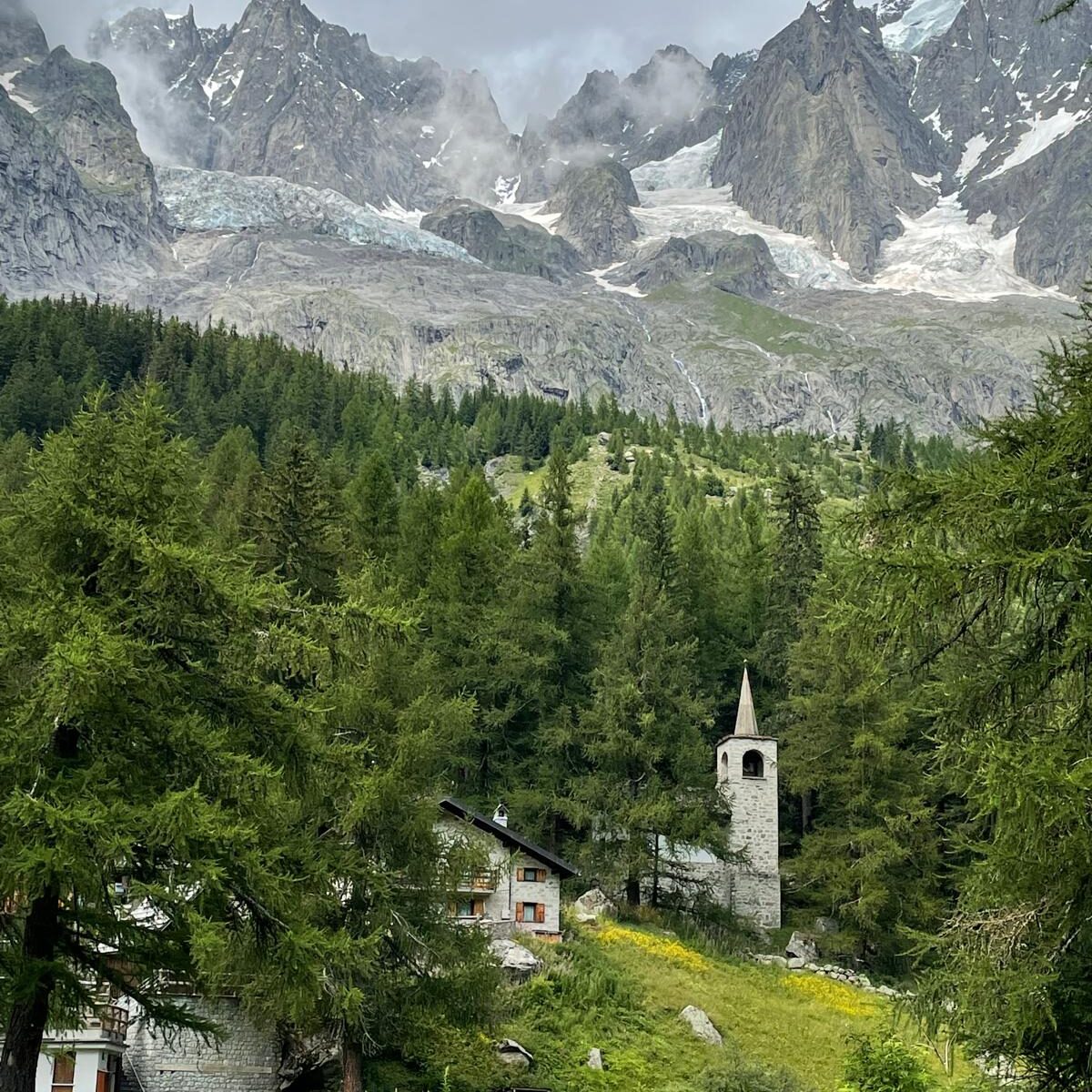
Planpincieux glacier and the church in the bottom. Photo: The-Ski-Guru.

The Planpincieux Glacier retreat is accelerating on the Italian side of Mont Blanc, seven years after the hanging glacier above Courmayeur first made international headlines over fears of a major collapse.

The hanging glacier, located above Val Ferret on the Italian side of the Mont Blanc massif, accelerated again during July 2026, reaching movement of around 80 centimetres per day. The figure was confirmed by the Valle d’Aosta regional authorities, which placed the glacier under continuous monitoring during the period of heightened activity.

The situation has since improved. Jean-Pierre Fosson of Fondazione Montagna Sicura said during the Valle d’Aosta stage of Legambiente’s Carovana dei Ghiacciai that Planpincieux has now fallen below the critical thresholds and that current conditions are considered favourable.

But the longer-term picture is far less reassuring.

Planpincieux Glacier retreat reaches 50 metres in three years

According to a report from Corriere della Sera, the front of Planpincieux has retreated by around 50 metres in just three years.

The glacier hangs at around 2,600 metres beneath the Grandes Jorasses, high above Val Ferret. Ice and debris continue periodically to break away from its front and descend towards the valley.

The glacier is particularly closely monitored because of its position above an inhabited and heavily visited valley.

During July’s acceleration, Courmayeur introduced Civil Protection restrictions in the areas potentially exposed to a collapse. Access restrictions were subsequently eased as conditions stabilised.


Read more: Nepal Glacier Disaster: Could It Happen in the Alps? — Following the catastrophic glacier-related disaster in Nepal, we look at whether similar high-mountain hazards could occur in the Alps, and how monitoring at Planpincieux, Blatten and elsewhere can provide crucial warning time.


Continue reading “Planpincieux Glacier: Seven Years After the Alarm, the Mont Blanc Glacier Is Retreating Fast”


Mont Blanc Faces Record Rockfall Year After Extreme Alpine Summer

The view from the top of the Skyway Monte Bianco - Punta Hellbronner- Amazing rotating gondola that takes you up to the highest point in Italy to see the Mont Blanc and all the surrounding mountains. Photo: The-Ski-Guru.

The Mont Blanc massif is facing a record rockfall year after an exceptionally hot Alpine summer destabilised high-altitude terrain — and scientists warn that some of the largest collapses may still be to come.

Around 450 significant rockfalls could be recorded in the Mont Blanc massif during 2026, according to geomorphologist Ludovic Ravanel, research director at France’s National Centre for Scientific Research (CNRS).

The figure would comfortably surpass the previous record of around 300 events in 2022, another year marked by intense heatwaves.

Just 10 or 20 years ago, only a few dozen such events would typically have been recorded.

Continue reading “Mont Blanc Faces Record Rockfall Year After Extreme Alpine Summer”

Aosta Valley Begins to Recover, but Record Glacier Loss Highlights Growing Climate Crisis

The view from Plan Chècrouit towards the Piscina Alpina in Courmayeur. Photo: The-Ski-Guru.

The Aosta Valley is beginning to recover after a week marked by intense storms, flooding and rockfalls, but scientists warn that the longer-term picture remains deeply concerning. While tourist facilities are reopening and emergency conditions are easing, 2026 has already become the worst year on record for glacier loss in Italy’s smallest Alpine region, underlining the accelerating impact of climate change. 

One of the clearest signs of recovery has come from Breuil-Cervinia, where the local golf course has partially reopened following the severe thunderstorms that hit the resort earlier this week. Although only a temporary nine-hole course is currently available while repairs continue, the reopening is an important step for the resort’s summer tourism industry after heavy rain and mudflows disrupted the area. 

Continue reading “Aosta Valley Begins to Recover, but Record Glacier Loss Highlights Growing Climate Crisis”