

Switzerland’s glaciers are shrinking rapidly, but their disappearance does not mean the country will simply run out of water. The bigger problem is when that water will be available — particularly during increasingly hot and dry Alpine summers.
Switzerland is often described as the “water tower of Europe”, while its rapidly retreating glaciers have become one of the most visible symbols of climate change in the Alps.
It is therefore easy to make a seemingly obvious connection: if the glaciers disappear, Switzerland will lose a major source of its water.
The reality is more complicated.
Swiss hydrologist Bettina Schaefli, professor at the University of Bern, recently challenged that assumption in an opinion piece published by Le Temps, arguing that Switzerland does not owe its abundant water resources primarily to its glaciers.
She is right — at least when looking at the country’s overall annual water balance.
Switzerland’s real hydrological advantage is the Alps themselves. The mountain barrier forces moist air upwards, producing substantial precipitation as rain and snow.
But that does not mean disappearing glaciers are irrelevant to Switzerland’s water supply.
Far from it.
What Switzerland is gradually losing is something particularly valuable: a natural water reserve capable of releasing water precisely when rainfall and snowmelt are no longer providing enough of it.
And during a drought, that distinction becomes crucial.
Glaciers provide only a fraction of annual runoff
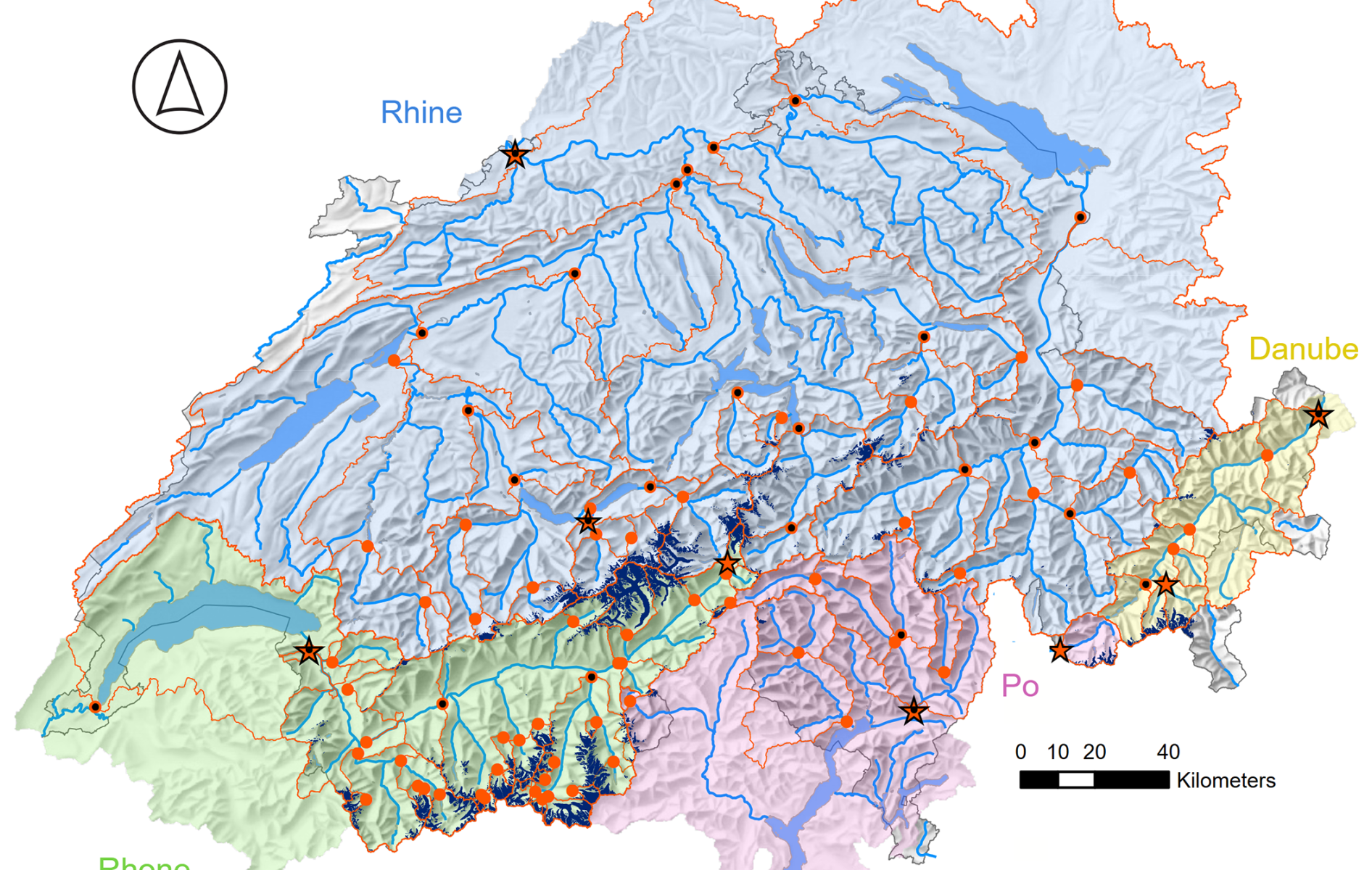
Research carried out under Switzerland’s federal Hydro-CH2018 programme quantified the contribution from rainfall, snowmelt and glacier melt in 190 glacierised headwater catchments across the Swiss Alps.
The results can initially sound reassuring.
Glacier melt currently accounts for around 8% of annual runoff across those catchments. Without strong climate mitigation, that contribution is projected to fall below 2% towards the end of the century.
Snow is considerably more important: its contribution to annual runoff was estimated at around 34%, potentially declining to approximately 25% by the end of the century in a high-emissions scenario.
So Switzerland is not simply drawing its water from a giant frozen reservoir in the mountains.
But annual averages conceal the most important part of the story.
The water arrives when Switzerland needs it most
Glaciers store precipitation over years, decades and even centuries.
Unlike rainwater, which can run quickly through a catchment, glacier ice can release stored water during exceptionally warm and dry periods.
That makes glaciers disproportionately important during summer droughts.
A peer-reviewed study published in Hydrology and Earth System Sciences in January 2026 examined the extraordinary Swiss drought of 2022, analysing 88 glacierised catchments.
Researchers found that glacier melt played a crucial role in sustaining downstream water supplies during the extreme heat and drought.
In catchments with around 15% glacier cover, increased glacier melt during summer was capable of completely compensating for deficits in precipitation and snowmelt.
The effect could be detected surprisingly far downstream.
At Basel on the Rhine, glaciers contributed only about 0.7% of annual streamflow in 2022 and around 4.4% over the summer as a whole.
Yet during parts of July and August, their contribution reached as much as 20%.
That is the paradox of Alpine glaciers as water reservoirs.
Their contribution may look relatively small when calculated across an entire year, but it can become significantly more important during precisely the weeks when water is scarce.
The 2026 drought is showing the problem again
This is not only a question for the end of the century.
Switzerland is experiencing the issue again in 2026.
Researchers from the Swiss Federal Institute for Forest, Snow and Landscape Research (WSL) and the WSL Institute for Snow and Avalanche Research (SLF) described the summer of 2026 as exceptionally hot and dry.
By July, record-low water levels had already been observed in several Swiss rivers.
The causes included low Alpine snowfall during the previous winter, substantially below-average rainfall since spring and repeated heatwaves.
Alpine regions initially benefited from snowmelt. But with limited winter snow accumulation, that buffer was also depleted unusually quickly.
Glacier melt has provided another temporary cushion.
According to WSL and SLF, some Alpine hydropower reservoirs have benefited from increased snow and glacier melt in 2026, partially compensating for the precipitation deficit.
But there is an uncomfortable reality behind that extra water.
It is coming partly from ice that is not being replaced.
Switzerland is spending its frozen savings
The distinction between normal glacier melt and glacier mass loss is important.
A glacier can be compared, imperfectly, with a savings account.
Seasonal snow accumulates and melts. But when summer melting removes more glacier ice than winter snowfall can replace, the glacier is effectively releasing stored capital.
The extreme summer of 2022 demonstrated this particularly clearly.
Swiss glaciers lost an estimated 3 cubic kilometres of ice that year, equivalent to approximately 2.6 cubic kilometres of meltwater from net mass loss.
Researchers calculated that 60–80% of glacier melt in 2022 came from net mass loss rather than a balanced annual cycle.
That water helped rivers during an exceptional drought.
But it also represented ice that had permanently disappeared from Switzerland’s glaciers.
And the ability of glaciers to provide that emergency buffer is already weakening.
There can be more melting but less meltwater
This is another counterintuitive consequence of glacier retreat.
Hotter temperatures do not necessarily mean that glaciers will continue producing ever-increasing quantities of water.
Eventually there is simply less ice available to melt.
The 2026 HESS study compared the extreme summers of 2003 and 2022.
Despite more intense melting per unit of glacier area in 2022, Switzerland’s glaciers collectively produced less total meltwater than in 2003.
Why?
Swiss glacier area had declined by approximately 21% between the two extreme summers.
In other words, higher melt rates were no longer sufficient to compensate for the amount of glacier that had already disappeared.
For many smaller Swiss glaciers, researchers found evidence that their contribution of meltwater during droughts has already begun to decline.
That is an important threshold.
The Alps are moving from a period in which accelerated glacier melting can temporarily increase water availability towards one in which continued glacier loss progressively reduces the amount of stored ice available to melt.
More winter water, less summer water
Switzerland’s federal hydrological scenarios point towards a broader transformation of the Alpine water cycle.
As temperatures rise, more winter precipitation will fall as rain rather than snow. Snow cover will form later and melt earlier.
Water will therefore move through the mountains sooner instead of remaining stored until spring and summer.
Without climate mitigation, Swiss federal projections indicate that winter runoff could increase by 10–50% by the end of the century, while summer and autumn runoff could decline by 30–50% compared with today.
In currently glacier-fed streams, summer reductions could reach as much as 60%.
The total amount of water flowing through Switzerland over an entire year is expected to change far less dramatically.
Again, the central problem is not simply how much water Switzerland receives.
It is when it receives it.
A country with plenty of water can still suffer water shortages
Switzerland is unlikely to become a water-poor country simply because its glaciers disappear.
The Federal Office for the Environment (FOEN) says the country generally continues to have abundant water resources.
But it also warns that water availability will increasingly become restricted in some regions during prolonged dry periods.
Climate projections show summer drought becoming both more frequent and more severe.
MeteoSwiss says that in a world 3°C warmer than pre-industrial conditions, a Swiss summer drought that historically occurred roughly once every ten years could occur around three times as often and be 44% drier on average.
That matters for far more than drinking water.
Agriculture, ecosystems, river temperatures, navigation and hydropower can all be affected when summer flows fall.
During the 2026 drought, restrictions have already been imposed on drawing water from some rivers, Alpine farms have faced shortages of water and fodder, and low flows have reduced production at some run-of-river hydropower plants.
The disappearance of glaciers changes the Alps beyond the landscape
Recent glacier-related events across the Alps and Himalayas have focused attention on another consequence of warming mountains: instability.
Retreating glaciers and thawing permafrost can contribute to rockfalls, landslides and other hazards, while newly exposed terrain and changing glacial lakes create additional risks.
But the transformation is also hydrological.
The loss of Alpine ice does not mean that Europe’s mountains suddenly stop receiving precipitation.
Instead, it removes part of the natural storage system that has historically delayed the journey of water from the mountains into rivers.
The difference sounds subtle.
In practice, it could become one of the defining challenges of a warmer Alpine climate.
Switzerland is not losing its water because it is losing its glaciers.
It is losing part of the system that has helped ensure water is still available when the summer turns hot and dry.
And the drought of 2026 is already providing a glimpse of why that matters.
Read More
Nepal Glacier Disaster: Could It Happen in the Alps?
Weisshorn Hanging Glacier Threatens Randa Near Zermatt
Planpincieux Glacier Retreat on Mont Blanc
Cervinia Redraws Landslide Risk Maps Amid €200 Million 3S Lift Project
Sources
NCCS — Hydro-CH2018 Research Projects
NCCS — Water Shortages in Summer
Hydrology and Earth System Sciences — Swiss Glacier Mass Loss During the 2022 Drought
WSL / SLF — The 2026 Drought: Frequently Asked Questions and Answers
Le Temps — La Suisse ne doit pas son eau à ses glaciers
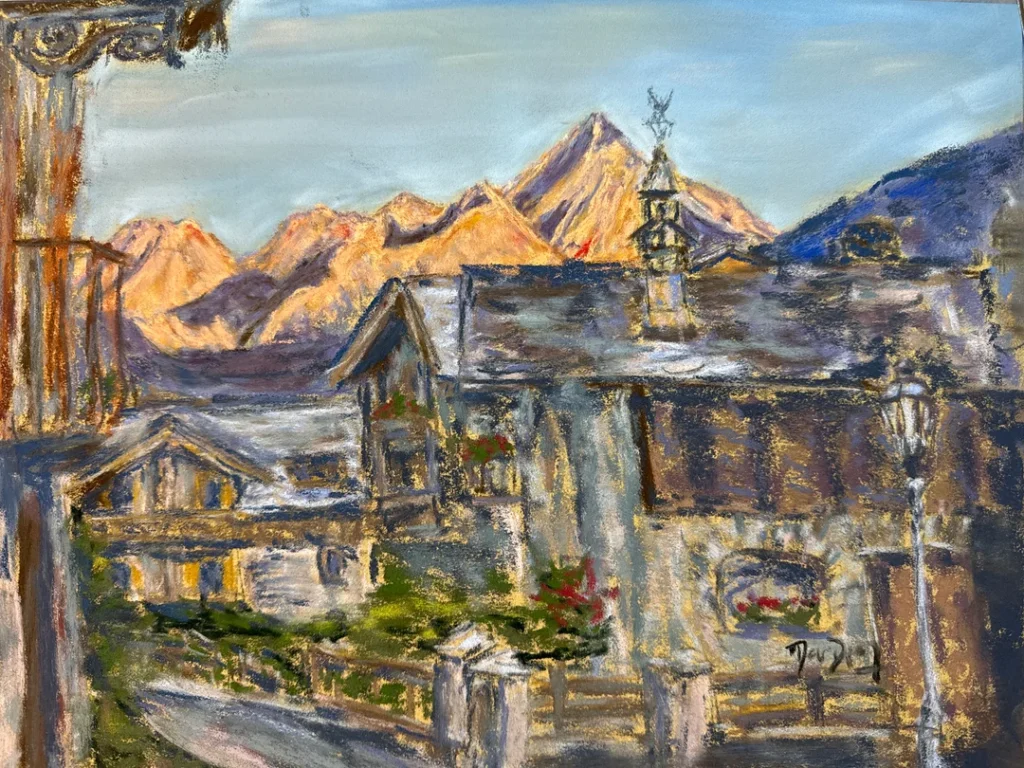
Planning your next trip to the Italian Alps?
If you’re heading to the Aosta Valley, take a look at Il Cuore della Valdigne, our family-owned apartment in Morgex, available for rent when we’re not using it ourselves.
It’s an ideal base to:
- Ski in Courmayeur, La Thuile and Pila
- Enjoy the mountains in summer (hiking, biking, nature)
- Explore the Mont Blanc valley in a quieter, more authentic setting.
Check my Mountain Art on my Shop
You can go to my shop and see what have been inspiring me lately, lots mountain landscapes in soft pastels, and now in oils too. Go here to check my latest works!
Featured Image: Map of hydrological Switzerland. Credit: Hess Copernicus.


Discover more from The-Ski-Guru
Subscribe to get the latest posts sent to your email.
 Subscribe to The-Ski-Guru here.
You must be logged in to post a comment.