

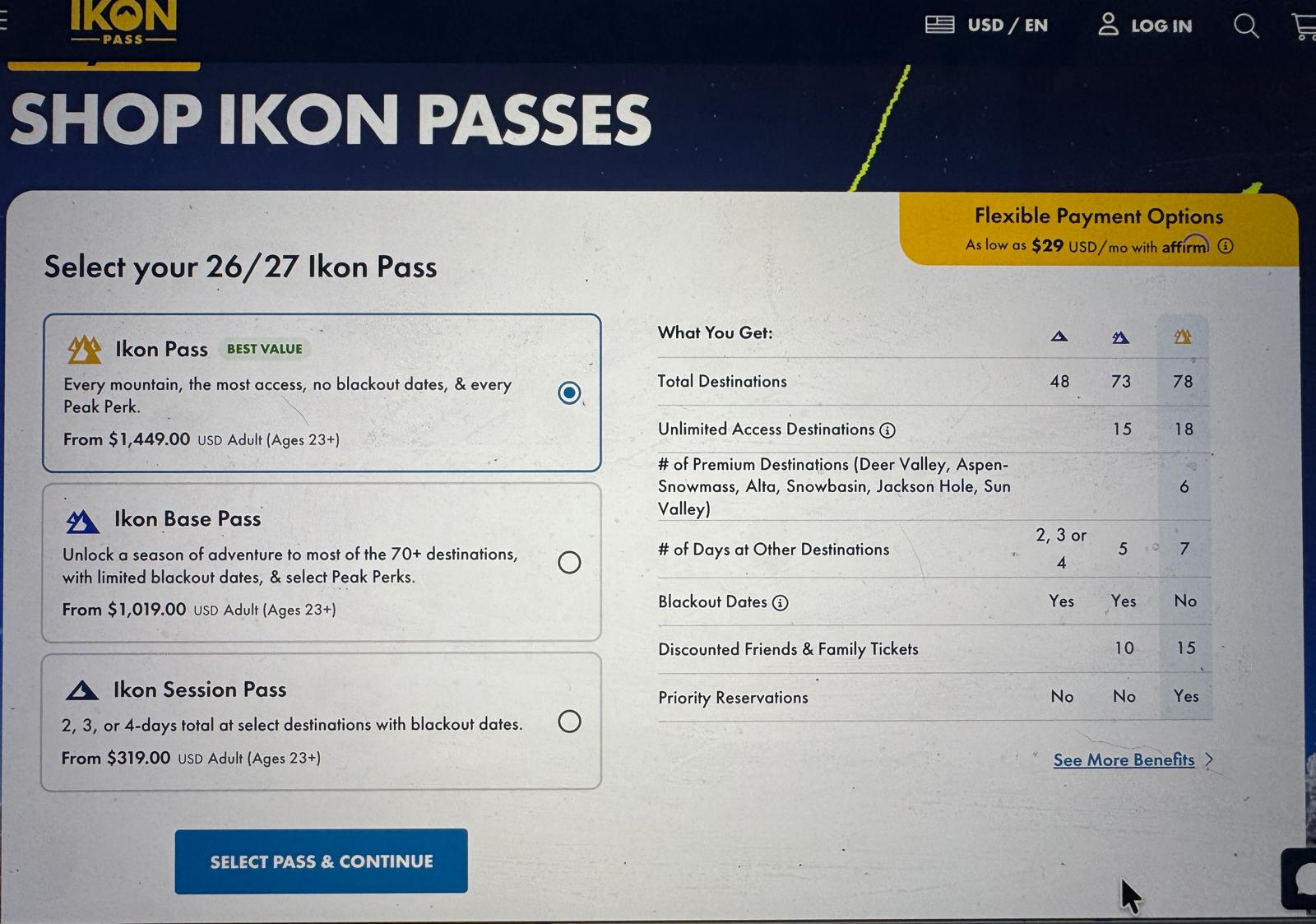
Ikon is pushing deeper into Asia, Indy Pass has grown beyond 300 resorts and a new Snow Pass has entered the market. Meanwhile, Epic is shifting its focus from expansion to guest experience. But across the Atlantic, Europe’s own multi-resort passes show that there is more than one way to build a ski empire.
The ski pass wars are no longer simply a battle between Epic and Ikon.
Ikon Pass has expanded its Asian footprint again for winter 2026/27, adding Madarao Mountain Resort in Japan and Beidahu and Lake Songhua in China.
On its own, that might look like another incremental expansion of an already enormous ski pass.
Look at what is happening across the wider market, however, and something more significant is emerging.
Ikon continues to build a worldwide collection of destination resorts. Epic, after years of acquisitions and international partnerships, is openly talking about improving what it already has. Indy Pass has assembled more than 300 mostly independent ski areas. Snow Pass has arrived as another lower-cost alternative.
And in Europe, regional passes such as Magic Pass, Ski amadé, Dolomiti Superski, the Valle d’Aosta regional pass and Mont Blanc Unlimited demonstrate yet another model: destinations cooperating across resorts, regions and even national borders without necessarily being owned by the same company.
The mega-pass may have won.
The next battle is over what kind of mega-pass skiers actually want.
Ikon keeps expanding the map
Asia is becoming increasingly important to Ikon’s proposition.
Japan is now represented by an increasingly broad collection of destinations, alongside resorts in China and South Korea.
That matters because Ikon is becoming much more than a North American season pass with a few overseas bonuses.
It is increasingly a product around which skiers can construct trips around the world.
Europe is already an important part of that strategy. The 2026/27 Ikon network includes Chamonix Mont-Blanc Valley, Dolomiti Superski, Grandvalira Resorts, Ischgl, Kitzbühel, Megève, St Moritz and Valle d’Aosta, among other European destinations.
And some of those names conceal considerable scale.
At Dolomiti Superski, Ikon access covers a network of 12 ski areas. In Valle d’Aosta, Ikon holders have combined access at five major ski areas: Cervino Ski Paradise, Courmayeur Mont Blanc, La Thuile–Espace San Bernardo, Monterosa Ski and Pila.
That makes Ikon increasingly difficult to describe simply in terms of the number of resorts.
It is becoming a global ski travel product.
Epic is saying something different
Perhaps the most interesting contrast comes from Vail Resorts.
For years, Epic’s story was expansion: acquire resorts, add partners and make the Epic Pass increasingly valuable by increasing the number of places where it could be used.
That phase is not necessarily over, but Vail Resorts is now publicly describing its next chapter differently.
In July, CEO Rob Katz said that for years Vail Resorts had focused on building the Epic Pass model and expanding its resort network. The company’s new Epic Experience strategy instead places the guest experience at the centre of its next phase of growth.
The multi-year plan includes investment in mountain food, ski and snowboard lessons, gear, digital guest engagement, customer support and staff, alongside the company’s continuing investment in mountain infrastructure. It is also launching Epic Ascent, a higher-touch private lesson experience.
It represents a subtle but important shift.
For Ikon, adding destinations continues to strengthen the proposition.
For Epic, the message is increasingly about getting more value — and loyalty — from the network it has already built.
That network remains huge. In Europe alone, Epic provides access to ten destinations, including Les 3 Vallées in France, Verbier 4 Vallées, Crans-Montana and Andermatt-Sedrun-Disentis in Switzerland, Skirama Dolomiti in Italy, and Ski Arlberg, Zillertal, Sölden, Silvretta Montafon and Saalbach & Zell am See-Kaprun in Austria. Access conditions vary by destination and pass type.
At Les 3 Vallées, for example, eligible full Epic Pass holders receive seven consecutive days across its seven resorts and 600km of skiing.
So Epic has hardly retreated from international skiing.
But the emphasis has changed.
Indy Pass offers the counter-revolution
Then there is Indy.
Its recent growth has been extraordinary.
The pass has pushed beyond 300 partner resorts, while continuing to sell itself not as another corporate ski empire, but as a way of supporting and exploring independent mountains.
That is the intriguing contradiction at the heart of Indy.
It is becoming a mega-pass by connecting ski areas that, culturally and commercially, often position themselves as the alternative to the mega-resort.
Its model is deliberately different from Epic and Ikon. Instead of encouraging unlimited use of a smaller number of owned mountains, Indy generally offers limited days at a very large collection of participating resorts.
And its expansion is increasingly international, with partners now stretching well beyond North America into Europe and Asia.
That gives the market three very different propositions:
Epic offers an integrated network built around owned resorts and major partnerships.
Ikon offers a global collection of destination resorts.
Indy offers scale through independence.
And now there is Snow Pass
There is room below the giants too.
Snow Pass is another entrant for 2026/27.
Its main product currently offers two visits at each of 14 partner mountains, followed by a 30% discount on additional visits, at a listed price of $339.99. Alongside it, the Snow Triple Play expands the choice to 26 mountains but provides three ski days in total.
It is nowhere near the scale of Epic, Ikon or Indy.
But perhaps that is the point.
The growth of Indy and the arrival of products such as Snow Pass suggest that the mega-pass revolution has created demand for a second generation of passes: cheaper, more limited and built around exploration rather than unlimited skiing at a corporate network.
Europe was doing mega-passes differently all along
The North American debate can sometimes give the impression that the multi-resort ski pass was invented with Epic.
Europe tells a rather different story.
European skiing has long operated through networks of independently operated resorts sharing lift tickets, infrastructure and marketing.
And some of those networks are enormous.
Magic Pass passes 100 resorts
Magic Pass is perhaps the closest European parallel to the Indy concept.
Created in Switzerland in 2017, it has expanded dramatically without needing to buy the ski areas within its network.
For 2026/27, Magic Pass says its network has passed 100 winter destinations, with resorts in Switzerland, France and Italy. Its ninth edition recorded a 63% increase in sales, according to the organisation.
Its next evolution is also interesting: mobility.
The new Magic Travel option integrates public transport into the subscription, moving the product beyond lift access and towards the question of how skiers actually travel between destinations.
Rather than simply adding skiing, Magic Pass is beginning to connect the journey as well as the mountains.
Valle d’Aosta: one pass, an entire region
Italy’s Valle d’Aosta provides an even better example of why European mega-passes do not fit neatly into the Epic-versus-Ikon narrative.
For years, the region has operated a unified regional ski-pass system covering its major resorts and smaller ski areas.
That brings together internationally known destinations such as Cervinia, Courmayeur, La Thuile, Monterosa Ski and Pila with the smaller mountains scattered across the region.
It is effectively a mega-pass built around geography rather than corporate ownership.
And now Valle d’Aosta also sits inside the global pass ecosystem.
For Ikon holders, the region counts as one destination: seven or five combined days, depending on the pass, across Cervino Ski Paradise, Courmayeur Mont Blanc, La Thuile–Espace San Bernardo, Monterosa Ski and Pila.
There is even an international wrinkle. Skiers can cross between Cervinia and Zermatt, although Ikon treats Valle d’Aosta and Zermatt as separate destinations and deducts a day from each allocation when both are skied on the same day.
This is where the pass landscape starts becoming particularly interesting.
A regional European ski system can now sit inside a global North American pass.
The networks are beginning to overlap.
READ MORE: Cervinia Redraws Landslide Risk Maps as €200m Cervino The One Lift Advances
Mont Blanc Unlimited takes the idea across borders
Few products illustrate the European approach better than Mont Blanc Unlimited.
Rather than connecting mountains because they belong to a single corporation, the pass builds a ski and mountain product around the wider Mont Blanc region.
It combines the Chamonix ski areas with Les Houches–Saint-Gervais and Evasion Mont-Blanc, while passes of two days or more also provide access, subject to conditions, to Courmayeur in Italy and Crans-Montana in Switzerland. Season and annual Mont Blanc Unlimited passes extend the network further, with conditional access to Verbier 4 Vallées.
Crans-Montana is an especially interesting example of this overlap: the Swiss resort is part of Mont Blanc Unlimited while also being majority-owned and operated by Vail Resorts and offering unlimited access to Epic Pass holders.
And it is not purely a ski product.
Depending on the pass duration, Mont Blanc Unlimited can also incorporate iconic mountain infrastructure and attractions including the Aiguille du Midi, Montenvers–Mer de Glace, Tramway du Mont-Blanc and Skyway Monte Bianco in Italy.
There is an important distinction: these ski areas are not all lift-linked. Mont Blanc Natural Resort itself makes that clear.
But that is precisely what makes the product interesting.
Mont Blanc Unlimited turns a stay in one Alpine region into access to a much broader cross-border mountain experience.
READ MORE: Mont Blanc Rockfalls Reach Record Levels in 2026
Dolomiti Superski: 1,200km on one pass
Then there are Europe’s giant ski networks.
Dolomiti Superski is perhaps the most obvious example.
It provides more than 1,200km of slopes across 12 ski areas in the UNESCO Dolomites with a single ski pass.
The network includes Cortina d’Ampezzo, Kronplatz, Alta Badia, Val Gardena/Alpe di Siusi, Val di Fassa/Carezza, Arabba/Marmolada, 3 Zinnen Dolomites and others.
And Dolomiti Superski now exists simultaneously as its own enormous European ski-pass system and as an Ikon partner.
Ikon holders receive seven or five combined days across the 12 Dolomiti Superski areas, depending on their pass.
Once again, one network sits inside another.
Ski amadé: 25 resorts with one ticket
Austria offers another model.
Ski amadé combines five regions, 25 ski resorts, up to 760km of slopes and 260 lifts under one ticket system.
From two days onwards, its multi-day tickets are valid throughout the Ski amadé network.
It is not Epic. It is not Ikon. And it is not a single interconnected ski area.
It is a huge regional alliance giving the consumer many of the same benefits associated with a mega-pass without requiring common corporate ownership.
And Ski amadé itself sits within an even larger product: its SuperSkiCard advertises access to 2,815km of pistes across 22 ski regions.
Europe also has mega-domains
There is one more category that should not be confused with any of the above: Europe’s huge interconnected ski domains.
Les 3 Vallées connects seven resorts across three valleys and around 600km of skiing.
Verbier 4 Vallées links six resorts across four valleys and more than 410km of pistes.
Then there are areas such as Portes du Soleil, Paradiski and Grandvalira.
These are not mega-passes in the North American sense. They are huge ski territories that can already be explored on a single local or regional pass.
Yet several are now also partners of the global passes.
Les 3 Vallées and Verbier 4 Vallées sit inside Epic.
Grandvalira sits inside Ikon.
The distinction between a ski area, a regional pass and a global pass is becoming increasingly blurred.
The pass is becoming a network of networks
Perhaps that is the biggest change.
It is increasingly difficult to draw a simple map of the ski-pass market.
A resort can belong to a regional pass, participate in a global pass and simultaneously retain its own lift-ticket system.
Valle d’Aosta is an Ikon destination.
Dolomiti Superski is simultaneously one of Europe’s great regional ski systems and an Ikon destination.
Les 3 Vallées is one of the largest interconnected ski domains in the world while also partnering with Epic.
Courmayeur participates in the Valle d’Aosta system and Mont Blanc Unlimited, while also forming part of Ikon’s Valle d’Aosta access.
And the global passes themselves increasingly contain entire regional networks rather than individual ski resorts.
The result is no longer simply a collection of mega-passes.
It is becoming a network of networks.
So who is winning the mega-pass war?
That may now be the wrong question.
Epic, Ikon, Indy, Magic Pass and Europe’s regional systems are increasingly selling different things.
Epic is betting on an integrated network and a more consistent customer experience.
Ikon is building a portfolio that allows skiers to move between major destinations around the world.
Indy is using scale to connect and market independent ski areas.
Snow Pass is testing whether there is room for smaller, lower-cost networks.
Magic Pass demonstrates how independent European resorts can achieve scale through cooperation.
And systems such as Valle d’Aosta, Mont Blanc Unlimited, Dolomiti Superski and Ski amadé show that a skier does not need a single corporate owner to gain access to an enormous mountain network.
The first generation of the mega-pass was largely about one question:
How many mountains can we put on one pass?
The second generation may be about something more complicated:
What kind of ski experience does that network actually create?
As the 2026/27 season approaches, that could become a much more interesting competition than the resort count alone.
SOURCES
Ikon Pass – 2026/27 destinations and access
Ikon Pass – 2026/27 Ikon Base Pass destinations
Vail Resorts – Epic Experience: new growth strategy
Epic Pass – European Resorts 2026/27
Magic Pass – 2026/27 official announcement
Magic Pass – 100+ destinations
Mont Blanc Natural Resort – Mont Blanc Unlimited
Mont Blanc Natural Resort – Season and annual Mont Blanc Unlimited
Dolomiti Superski – 12 ski areas and 1,200km
Ski amadé – 25 resorts, 760km and 260 lifts
Ski amadé – Ticket validity across the network

Planning your next trip to the Italian Alps?
If you’re heading to the Aosta Valley, take a look at Il Cuore della Valdigne, our family-owned apartment in Morgex, available for rent when we’re not using it ourselves.
It’s an ideal base to:
- Ski in Courmayeur, La Thuile and Pila
- Enjoy the mountains in summer (hiking, biking, nature)
- Explore the Mont Blanc valley in a quieter, more authentic setting.
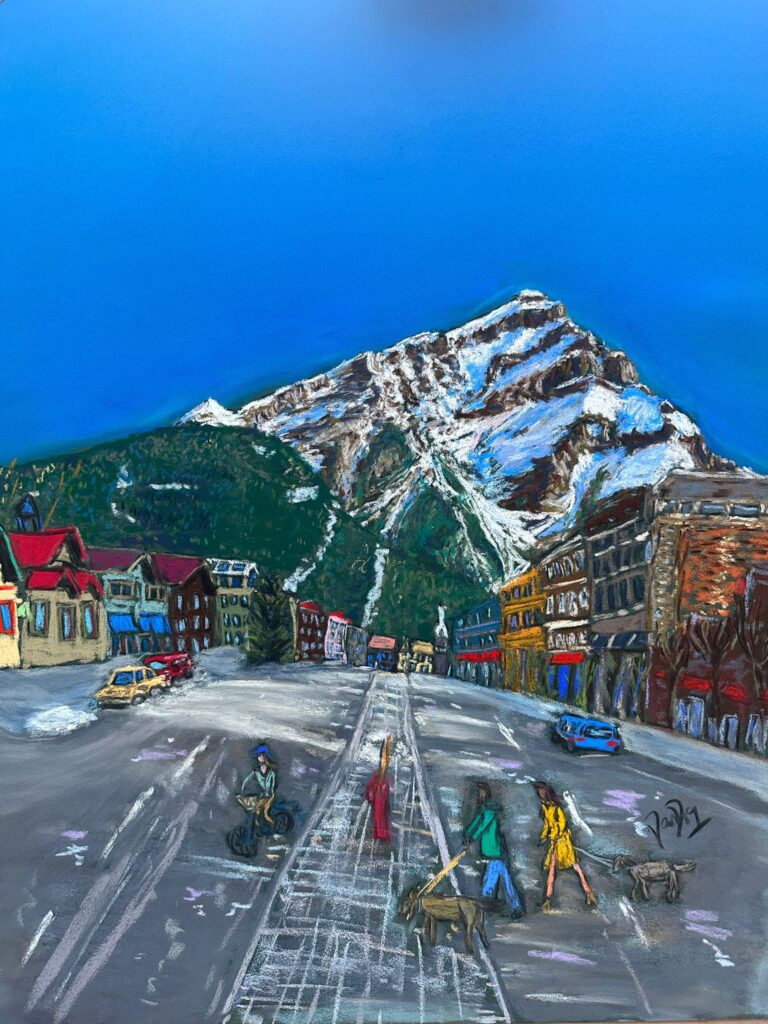
Check my Mountain Art on my Shop
You can go to my shop and see what have been inspiring me lately, lots mountain landscapes in soft pastels, and now in oils too. Go here to check my latest works!
Featured Image: Ikon Pass sales platform. Credit: Alterramtnco.com


Discover more from The-Ski-Guru
Subscribe to get the latest posts sent to your email.
 Subscribe to The-Ski-Guru here.
You must be logged in to post a comment.