


Introduction
A series of recent avalanches across the French Alps is highlighting a dangerous spring transition in the snowpack, with multiple size 3 avalanches recorded in early April 2026.
Observations reported via data-avalanche.org show a mix of natural and human-triggered avalanches across the Vanoise and Haute Tarentaise regions.
👉 These developments follow broader instability patterns seen earlier this season — see February 2026 Avalanche Cycle Across the Alps.
Where the Avalanches Occurred
Key events (2–4 April 2026)
At Cime des Planettes in the Vanoise on 4 April, a size 3 avalanche released spontaneously around midday and was observed by ski patrol in Aussois. The timing is consistent with typical spring warming patterns.
In the Mont Thabor sector on 2 April, the entire east-facing slope of the Roche du Chardonnet released as skiers were descending. This is a well-travelled ski touring route, increasing the potential exposure.
Also on 2 April in the Vanoise, a remote-triggered avalanche occurred at Pointe de l’Échelle, caused by a group of ski tourers.
In Haute Tarentaise, near Pointe de Boussac and Pointe de Grapillon, a size 3 avalanche was triggered by skiers. One person was partially buried and later evacuated by helicopter by rescue services. The fracture depth ranged between 40 and 70 centimetres, with propagation across approximately 60 metres.
What Size 3 Avalanches Mean
On the European scale, a size 3 avalanche is classified as large and capable of burying or injuring a person, as well as running significant distances.
👉 For context, see Understanding the European Avalanche Danger Scale: Levels 1–5 Explained.
A Clear Spring Pattern: East-Facing Slopes Under Stress
Most of the avalanches occurred on east to south-east aspects, reflecting a classic spring pattern driven by solar radiation. Slopes that remain cold in the morning can destabilise rapidly as the sun gains strength, particularly from late morning into early afternoon.
This timing is typical of spring avalanche cycles, where warming rather than snowfall becomes the dominant destabilising factor.
👉 This aligns with conditions often seen at Level 3 (“Considerable”) avalanche danger — see Avalanche Danger Level 3 Explained: What “Considerable” Really Means.
Hidden Weak Layers Between Crusts
One of the most important observations from these reports is the presence of thin weak layers trapped between melt-freeze crusts.
This creates a deceptively unstable snowpack. While the surface may appear stable, deeper weak layers can persist and allow fractures to propagate over wide areas.
These types of structures are particularly dangerous because they are difficult to detect and can lead to large avalanches even under moderate additional load.
👉 This type of instability can escalate toward conditions described in What Level 4 Avalanche Danger Means.
Human Factors: Tracks, Timing and Exposure
Several of the incidents reflect recurring human factors in avalanche accidents. Skiers were observed cutting slopes above others, increasing exposure to those below. In some cases, routes followed mapped itineraries despite unstable conditions, creating a false sense of security.
The timing of these events during Easter also likely contributed to increased traffic in the backcountry.
Even where spacing techniques were used, avalanches were still triggered, including remotely, showing how sensitive the snowpack has become.
A Broader Pattern, Not Isolated Incidents
These avalanches should not be viewed as isolated incidents. They reflect a broader spring transition in Alpine snowpacks, where melt-freeze cycles create complex layering and solar radiation rapidly destabilises slopes.
👉 For a deeper look at how avalanche risk is managed in ski areas, see Avalanche Control on Ski Slopes: The System Behind “Safe In-Bounds Skiing”.
👉 You can also explore how warming trends are affecting snow stability in Snow Conditions in a Warming Alpine Climate.
Conclusion
The recent avalanches in the French Alps highlight how spring conditions can combine hidden structural weaknesses with increased skier exposure.
Even without major snowfall events, the interaction between weak layers, solar warming and human presence can produce large and dangerous avalanches.
Latest Avalanche Activity (5 April 2026): Skier Burial in Névache and Widespread Instability Continues
New reports logged on data-avalanche.org on 5 April confirm that unstable snowpack conditions persist across multiple Alpine massifs, with both human-triggered and spontaneous avalanches continuing to occur.
In the Cerces massif, near Névache at Lac Cristol, a ski tourer was fully buried in an avalanche and remained under the snow for approximately seven minutes. He was first rescued by his companion before the arrival of the PGHM rescue team from Modane. The victim, who suffered spinal injuries, was evacuated to hospital in Grenoble. The incident highlights once again how survival often depends on immediate companion rescue in avalanche accidents.
Elsewhere, in the Lauzière massif near the Cheval Noir (Combe de la Rave), a spontaneous slab avalanche released around 2,550 metres on an east to south-east aspect. The crown was estimated at 30–40 cm, producing a size 2 avalanche with deposits reaching up to two metres in depth. A search operation was carried out due to the popularity of the route, but no victims were found.
In the Vanoise sector below the Pointe de Méribel, two ski tourers triggered successive slab avalanches during their descent. After identifying unstable snow near a col, one skier descended first and stopped in a safe zone, warning of slab presence. A first release triggered by the second skier propagated further, causing an additional fracture of around 30 cm and mobilising a significant volume of snow. The incident illustrates classic slab reactivity and propagation under current conditions.
Additional activity reported across recent days reinforces the broader pattern. In the Lauzière (Saint-François-Longchamp sector), numerous avalanches were observed on 4 April, mostly size 1 with some size 2 events and at least one reaching size 2–3 on south-east aspects. In the Dévoluy massif on 3 April, a large slab reportedly released remotely between the Col des Rougnoux and the Col du Countet, underlining that dangerous conditions can persist even during periods rated at Level 2 (“Moderate”) on the European avalanche danger scale.
Further south in the Thabor area, a significant spontaneous release occurred on 2 April on the east face of the Roche du Chardonnet, near Mont Thabor. The entire slope released while skiers were nearby, fortunately without involvement. The slope is part of a commonly used ski touring route, raising concerns about route choice and terrain exposure under current snowpack conditions.
👉 You can read more about how these patterns fit into the wider cycle here: February 2026 Avalanche Cycle Across the Alps
👉 And for context on risk levels: European avalanche danger scale (Levels 1–5 explained)
Sources
- data-avalanche.org
- Field observations (ski patrol, PGHM rescue reports)

 Planning your next trip to the Italian Alps?
 Planning your next trip to the Italian Alps?
If you’re heading to the Aosta Valley, take a look at Il Cuore della Valdigne, our family-owned apartment in Morgex, available for rent when we’re not using it ourselves.
It’s an ideal base to:
 Ski in Courmayeur,
 Enjoy the mountains in summer (hiking, biking, nature)
Check my Mountain Art on my Shop
You can go to my shop and see what have been inspiring me lately, lots mountain landscapes in soft pastels, and now in oils too. Go here to check my latest works!

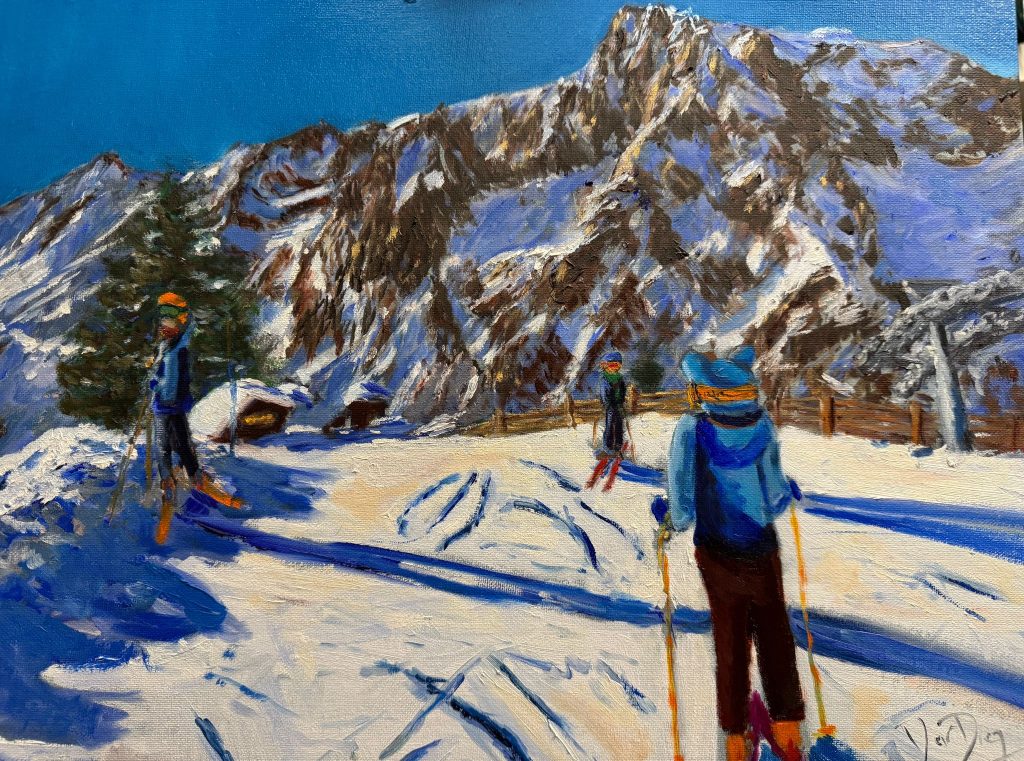
Skiing from Zerotta. Oils on panel. 18″x15″. In my shop.
Featured Image: Crown Fracture of a huge snow slab-avalanche. Researchgate.net


Discover more from The-Ski-Guru
Subscribe to get the latest posts sent to your email.
 Subscribe to The-Ski-Guru here.