

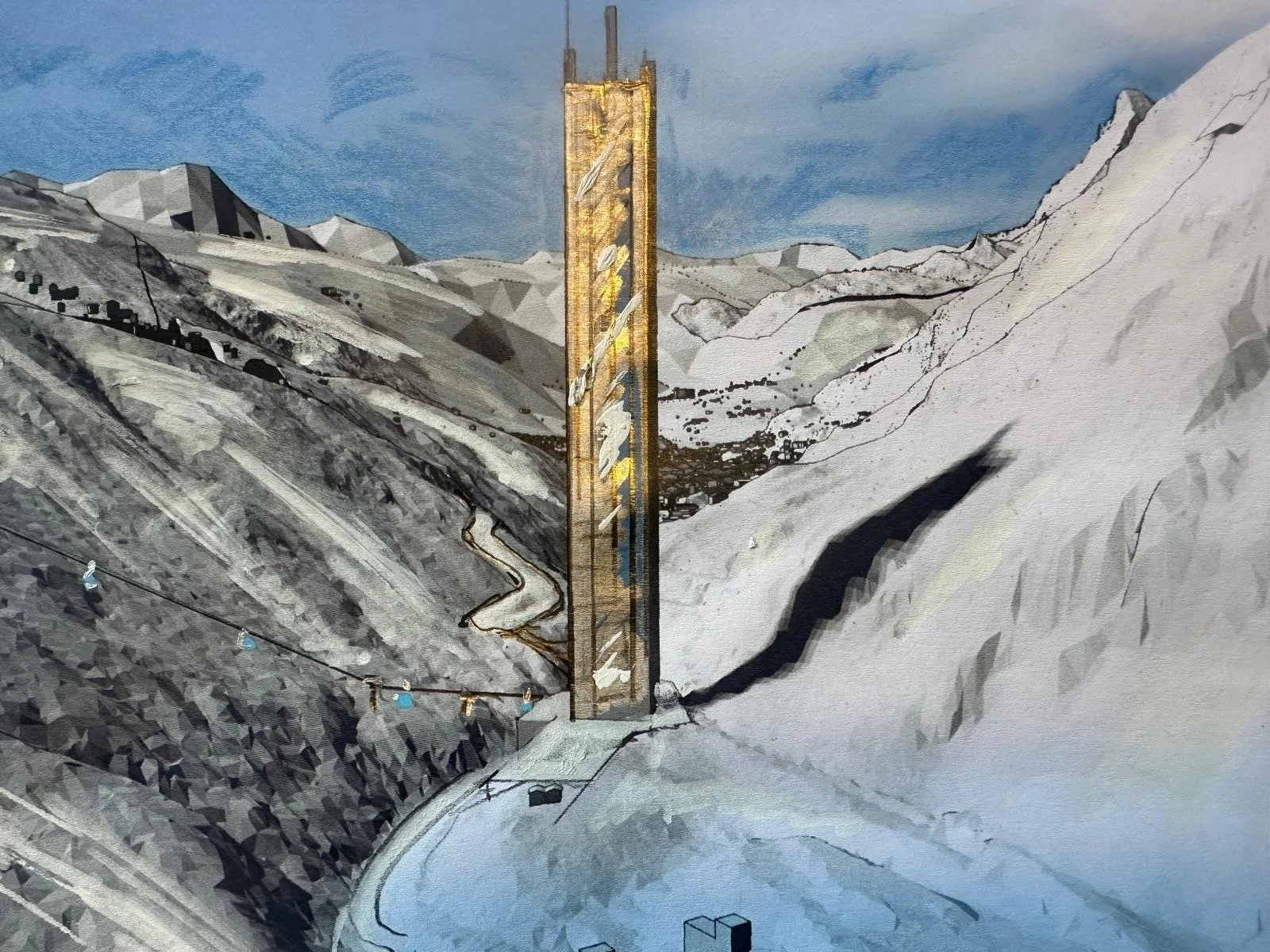
A proposed 260-metre residential tower near Zermatt has reopened one of the most difficult questions facing high-profile Alpine resorts: how do ski towns house the people who make tourism possible, when land is scarce, property prices are soaring and local workers are increasingly pushed out?
The project, called Lina Peak, is the idea of Zermatt-born artist, architect and hotelier Heinz Julen. It would be a striking departure from the image most visitors associate with Zermatt: not a low-rise chalet-style development, but a vertical “village” rising near one of the most famous mountain landscapes in the world. According to the project’s own website and Swiss media reports, the tower would stand around 260 metres high and include housing, public services, parking, leisure facilities and a potential link into the ski area.
The proposal has already divided opinion in Zermatt. Supporters see it as a bold attempt to address a real and worsening housing shortage. Critics see it as too much, too high and too visually disruptive for one of the most iconic Alpine destinations.
The most important point, however, is that Lina Peak is not just an architecture story. It is a ski resort housing story.
Why Lina Peak is being proposed
Zermatt has a permanent population of roughly 5,800 people, but it operates as one of the busiest mountain destinations in Europe. Hotels, restaurants, lift operations, ski schools, taxis, shops and service businesses depend heavily on local and seasonal workers. Yet, as in many successful ski resorts, the very tourism economy that sustains the village has also pushed housing further out of reach.
Swissinfo reported that the proposed site would be in the lower part of Zermatt, around 800 metres from the entrance to the village, on farmland at approximately 1,500 metres altitude. The project would include a large base with parking, public facilities and services, with residential floors above. The lower residential levels would be reserved for locals and seasonal workers, while the upper floors would be luxury apartments.
That structure is central to Julen’s argument. The project is being presented not simply as a luxury real-estate development, but as a way to cross-finance more affordable housing in a resort where normal market prices are increasingly inaccessible to many of the people who work there.
According to Rhône FM, Julen has argued that Zermatt’s limited building land leaves only one real option: building upwards. He has also said the project could offer homes at prices below the current market, giving younger residents and local workers a chance to stay in the resort.
What the tower would include
The scale of Lina Peak is what makes it so controversial. The project has been described as a 62- to 65-storey tower, depending on the source, rising to around 260 metres. If built, it would be one of the most radical pieces of mountain architecture in the Alps.
Swissinfo reported that the project would include housing for residents and seasonal workers, luxury apartments on the higher floors, restaurants, shops, a nursery, a sports centre, a swimming pool, a roof terrace and a large parking base. Bluewin also reported that the plan includes a visitor centre concept and a new gondola link designed to connect the tower more directly with the ski area, reducing pressure on the centre of Zermatt.
Rhône FM reported that the proposed gondola would be around 950 metres long and would connect Lina Peak with the Kumme-Bahn area, with the stated aim of easing pressure on the village centre and moving some visitor flows away from Zermatt’s most congested points.
That is why the project goes beyond housing. It also touches on transport, overtourism, infrastructure, resort access and the long-term management of a destination that is already under pressure from its own success.
Has Lina Peak been approved?
No final approval has been reported.
This is still a long way from construction. Bluewin reported that 600 signatures would first be needed to demand the rezoning of the agricultural land into a building zone, after which there would be a referendum. Rhône FM later reported that around 300 signatures had reportedly been collected towards the 600 needed for Zermatt residents to vote on the issue.
That means the project is not yet a done deal. It is better understood as a serious proposal that has entered the local political debate, rather than as an approved skyscraper about to rise beside the Matterhorn.
There is also an important planning question behind the headlines. The land is currently agricultural, so the project would need a change in local planning rules before it could move forward. In a Swiss mountain community where direct democracy and local votes matter, that is a major hurdle.
Why the debate matters beyond Zermatt
It would be easy to dismiss Lina Peak as an eccentric one-off: a skyscraper in a car-free Alpine resort, proposed by a famously unconventional local designer, in the shadow of the Matterhorn.
But the underlying problem is not eccentric at all.
Across the Alps and North America, successful ski resorts are increasingly struggling with the same issue. Tourism depends on workers, yet those workers often cannot live near the resort. Housing is converted into second homes, holiday rentals or high-end property investments. Local families are priced out. Seasonal employees commute from farther away or leave the sector altogether. Businesses then struggle to recruit and retain staff.
Zermatt’s version of this problem is extreme because the resort is globally famous, geographically constrained and highly desirable. But the pattern is familiar from many mountain destinations.
That is what makes Lina Peak worth watching. Even if the tower is never built, it forces a difficult conversation: are traditional low-rise Alpine building models enough to solve today’s housing crisis in the most pressured ski resorts? Or will destinations eventually have to accept much denser, more urban forms of development to keep their tourism economies functioning?
The risk of solving one problem by creating another
The strongest argument in favour of Lina Peak is practical. Zermatt needs housing. Land is limited. Workers need somewhere to live. If building outward is not possible, building upward may look like the only remaining option.
But the criticism is also serious.
A 260-metre tower would fundamentally change the visual language of Zermatt. Even if the project is placed outside the historic village centre, it would still become a powerful new landmark in a destination whose brand is built around mountain scenery, tradition and the Matterhorn itself.
There is also the question of whether luxury apartments on the upper floors would worsen the same market pressure the project claims to address. If affordable housing depends on high-end property sales, the resort may still be tying its future to the very forces that have made housing unaffordable in the first place.
Bluewin raised exactly that unresolved question: whether Lina Peak would provide a remedy, or whether it could make the problem worse.
A symbol of the next Alpine planning battle
As I see this, the Lina Peak debate belongs in the same wider conversation as mountain infrastructure risk in the Alps, ski resort operations in a changing mountain climate, and the growing challenge of keeping high-value resorts liveable for the people who work in them.
The Alps are not static museum landscapes. They are working mountain economies, and those economies need housing, transport, utilities, avalanche protection, lifts, roads, energy and year-round services. At the same time, the identity of Alpine resorts depends on landscape, scale, heritage and a sense of place.
That is the conflict Lina Peak exposes so clearly.
It may never be built. It may be reduced, rejected or redesigned. But the fact that such a proposal is being discussed in Zermatt shows how severe the pressure has become.
In that sense, Lina Peak is less a story about one skyscraper than a warning sign for Alpine tourism. The housing crisis in ski resorts is no longer a background issue. It is moving to the centre of debates about what these destinations can become, who they are for, and whether the people who keep them running can still afford to live there.
Sources:
Lina Peak official project website
https://www.linapeak-zermatt.com/
Bluewin – Planned Lina Peak skyscraper divides Zermatt
https://www.bluewin.ch/en/news/planned-lina-peak-skyscraper-divides-zermatt-2983844.html
Swissinfo – A 260-metre skyscraper in Zermatt?
https://www.swissinfo.ch/eng/swiss-oddities/a-260-metre-skyscraper-in-zermatt/90460061
Rhône FM – Bientôt un gratte-ciel de 65 étages face au Cervin?
https://www.rhonefm.ch/valais/bientot-un-gratte-ciel-de-65-etages-face-au-cervin-le-projet-fou-qui-divise-la-station-de-zermatt-1390269
 Planning your next trip to the Italian Alps?
 Planning your next trip to the Italian Alps?
If you’re heading to the Aosta Valley, take a look at Il Cuore della Valdigne, our family-owned apartment in Morgex, available for rent when we’re not using it ourselves.
It’s an ideal base to:
- Ski in Courmayeur, La Thuile and Pila
- Enjoy the mountains in summer (hiking, biking, nature)
- Explore the Mont Blanc valley in a quieter, more authentic setting.
Check my Mountain Art on my Shop
You can go to my shop and see what have been inspiring me lately, lots mountain landscapes in soft pastels, and now in oils too. Go here to check my latest works!
Featured Image: Lina Peak rendering. www.linapeak-zermatt.com


Discover more from The-Ski-Guru
Subscribe to get the latest posts sent to your email.
 Subscribe to The-Ski-Guru here.