

A €4 krapfen served at a mountain hut high in the Italian Dolomites has become the latest symbol of a much bigger problem facing some of Europe’s most spectacular mountain destinations: what happens when a place suddenly goes viral.
The Friedrich August refuge, located at around 2,300 metres between Col Rodella and Passo Sella in Val di Fassa, has long been known for serving freshly made krapfen, the jam-filled fried pastries common across the Alpine region.
But after videos of the pastries began spreading across social media, the hut itself became a destination.
Visitors are now reportedly arriving early in the morning — and in some cases even camping nearby — to make sure they can buy one before supplies run out. Long queues have formed outside the refuge, while photographs and videos of the pastry against the dramatic Dolomite backdrop continue to circulate online.
What might appear to be a slightly absurd story about people hiking into the mountains for a doughnut is actually part of a much larger transformation taking place across the Alps.
From Seceda and Lago di Braies to Lago di Sorapis and the Tre Cime di Lavaredo, social media is increasingly capable of directing thousands of visitors towards the same trail, viewpoint or mountain hut.
And Alpine destinations are beginning to respond.
From Mountain Hut to Viral Destination
The Friedrich August refuge has not suddenly invented the krapfen.
The pastries have been made there for decades. What has changed is their visibility.
Food bloggers and travel influencers have turned the experience into easily shareable content: the preparation of the pastry, the mountain setting and finally the obligatory photograph.
According to The Guardian, the phenomenon has grown to the point where hundreds of visitors can queue for the pastries, creating a situation that has surprised even the people running the refuge.
The concern extends beyond one mountain hut.
Marco Bussone, president of UNCEM, the organisation representing Italy’s mountain municipalities and communities, told the newspaper that social-media algorithms can suddenly direct large numbers of people towards particular locations.
Francesco Abbruscato, president of the Veneto branch of the Italian Alpine Club (CAI), also pointed to an increasingly visible form of overtourism concentrated around iconic Dolomite locations.
The problem is not necessarily that more people want to experience the mountains.
It is that enormous numbers can now be directed towards exactly the same place at exactly the same time.
Seceda: From Instagram Icon to Visitor Limits
Few places illustrate the transformation better than Seceda above Val Gardena.
Its extraordinary ridgeline overlooking the Odle peaks has become one of the most recognisable mountain photographs on social media.
But the popularity of the image has had consequences on the ground.
RAI reported earlier this year that Seceda was receiving around 4,000 to 6,000 visitors per day during summer, many arriving primarily to take photographs of the famous panorama.
For summer 2026, local authorities and lift operators moved towards limiting daily numbers to around 3,000–4,000 visitors, while the price of the cable car was increased.
The situation has also produced one of the most controversial responses to Dolomite overtourism.
Private landowners installed a turnstile on the panoramic trail and began charging visitors €5 to cross their land, saying they were exhausted by thousands of people passing through each day.
The turnstile first caused controversy in 2025. It returned again this summer.
The Province of Bolzano has sought legal advice over the measure, while the broader question of how to manage access to Seceda remains unresolved.
What was once simply a spectacular mountain viewpoint has effectively become a global photographic destination.
Lago di Braies: Managing the Instagram Postcard
Lago di Braies is another example of what happens when a mountain landscape becomes instantly recognisable online.
The turquoise Dolomite lake has become one of Italy’s most photographed Alpine locations.
ANSA described it this year as a tourist hotspot regularly overwhelmed by “selfie tourists” who arrive, photograph the lake, publish the image on social media and return to the valley.
The pressures have become substantial enough that access has had to be actively managed.
During the busiest summer periods, motorists must reserve access in advance, while visitors are encouraged to arrive by public transport, shuttle bus, bicycle or on foot.
The issue is not purely one of inconvenience.
In April 2026, five people had to be rescued after the spring ice gave way beneath visitors walking on the frozen lake. Authorities subsequently warned tourists not to venture onto the ice.
The episode highlighted another potential consequence of social-media tourism in mountain environments: visitors attracted primarily by an image may not always understand the risks associated with the landscape they have come to photograph.
Lago di Sorapis: Thousands of People on a Mountain Trail
The phenomenon becomes even more striking at Lago di Sorapis, above Cortina d’Ampezzo.
Unlike many heavily visited Alpine attractions, Sorapis cannot simply absorb visitors through a large road network or cable-car system.
Reaching its distinctive turquoise waters requires walking a mountain trail.
Yet the lake’s extraordinary colour has made it another social-media favourite.
Corriere della Sera has reported that Sorapis has generated tens of thousands of Instagram posts and can attract as many as 3,000 people in a single day.
Reports of overcrowding there are not new. As far back as 2018, the manager of the nearby Rifugio Vandelli was describing days with 2,000 visitors and peaks approaching 3,000, together with the resulting problems of rubbish and pressure on the surrounding environment.
Social media does not therefore need to overwhelm an entire resort to create overtourism.
It can concentrate enormous numbers onto one trail, one lake or one viewpoint.
Tre Cime di Lavaredo: Queues in the Mountains
This summer has provided another striking example.
In July, footage showed an enormous queue of hikers waiting for shuttle buses towards Rifugio Auronzo, the principal starting point for the famous circuit around the Tre Cime di Lavaredo.
The images circulated widely on social media and reignited the debate about overtourism in the Dolomites.
The irony is difficult to miss.
Visitors travel into the mountains partly to escape crowded urban environments, only to find themselves standing in queues that increasingly resemble those of major tourist attractions.
Tre Cime also demonstrates the scale of the challenge facing destination managers.
Restricting private cars or encouraging shuttle buses can reduce congestion and environmental pressure, but it does not necessarily reduce the underlying demand to visit the same globally recognised location.
South Tyrol Is Already Experimenting With Solutions
Authorities are increasingly recognising that simply promoting responsible behaviour may no longer be enough.
South Tyrol introduced a pilot programme this summer involving 15 Südtirol Alto Adige Rangers deployed at heavily visited locations including Lago di Braies, Seceda, the Dolomite passes, Alpe di Siusi and Lago di Carezza.
Their role includes explaining appropriate behaviour in the natural environment and helping protect particularly pressured locations.
More structural restrictions are also coming.
From summer 2027, Passo Gardena is expected to introduce what has been described as an anti-overtourism restricted traffic zone. Access between May and October will largely be reserved for local residents and authorised traffic, while hikers will have 150 bookable parking spaces and public transport services are expected to increase.
The evolution is significant.
For decades, Alpine destinations invested heavily in making mountains easier to reach.
Roads, cable cars, car parks and sophisticated lift networks opened extraordinary landscapes to millions of visitors.
Social media has added something entirely new to that infrastructure: an extraordinarily powerful global marketing system that destinations themselves do not control.
This Is Not Only a Summer Problem
The phenomenon is not confined to hiking destinations or the Dolomites.
In January 2025, Roccaraso in the Italian Apennines experienced perhaps one of the most dramatic examples of influencer-driven tourism.
Around 10,000 day visitors descended on the ski destination in a single day, many arriving from Naples aboard more than 200 coaches after low-cost trips to the resort were heavily promoted through TikTok and social media.
The sudden influx overwhelmed roads and infrastructure and ultimately led authorities to introduce restrictions on the number of tourist buses allowed into the resort.
It demonstrated how quickly an online trend can become a physical problem for a mountain community.
Read more: Overtourism in Roccaraso: 10 Thousand Neapolitan Skiers Descend on Ski Resort
Pila Shows That Sudden Overcrowding Has Other Causes Too
Not every sudden surge in mountain visitors, however, can be blamed on social media.
A different dynamic was observed at Pila, in the Aosta Valley, during the 2025/26 ski season, when the resort experienced an exceptional concentration of skiers and record attendance.
Unlike Roccaraso, where the surge was driven by organised low-cost coach trips amplified through social media, Pila’s record attendance resulted from a different combination of factors.
Strong winds affected several other resorts in the Aosta Valley, including Cervinia, redirecting skiers towards Pila, where conditions were more sheltered. Favourable snow conditions and heavy weekend demand added to the sudden concentration of visitors.
The episode therefore differed from the influencer-driven phenomenon seen at Roccaraso, but it underlined a related challenge for mountain destinations: large numbers of visitors can shift very quickly towards a single resort when weather, accessibility and demand align, temporarily putting infrastructure under considerable pressure.
Pila is an important distinction. Social media may be creating new patterns of overtourism, but it is not the explanation for every crowded mountain.
Weather disruptions, lift closures, snow conditions, traffic patterns and the redistribution of skiers from neighbouring resorts can produce similar concentrations.
What digital platforms have added is another increasingly powerful — and sometimes unpredictable — trigger.
Read more: Pila Records Unprecedented Visitor Numbers During 2026 Ski Season
The Paradox Facing Mountain Tourism
There is an uncomfortable paradox behind all of this.
For generations, mountain destinations have spent enormous amounts of money persuading people to visit.
Tourism boards produced brochures, attended trade shows, hosted journalists and tour operators and later invested heavily in websites and digital marketing.
Success was measured in visitors, overnight stays and international awareness.
Social media can now achieve that visibility almost instantly — but without necessarily directing visitors where destinations want them to go.
A single spectacular video can focus demand on one lake rather than an entire valley, one viewpoint rather than dozens of trails, or even one pastry at one mountain hut.
The result is a new form of highly concentrated tourism.
The wider destination may not necessarily be full. The hotel beds may not all be occupied. Other trails may remain relatively quiet.
Yet one particular location can be overwhelmed.
That creates a fundamentally different management problem.
From Attracting Visitors to Managing Them
The response emerging across the Dolomites suggests that the role of mountain tourism authorities may gradually be changing.
Marketing remains important, but visitor management is becoming equally important.
Reservations at Lago di Braies, proposed daily limits at Seceda, shuttle systems at Tre Cime, rangers at popular South Tyrolean locations and future traffic restrictions at Passo Gardena are all variations on the same idea: demand can no longer simply be encouraged. At certain locations, it must also be managed.
There is also a larger question about what visitors expect from the mountains.
Wanting to photograph an extraordinary landscape is hardly new. Neither is travelling somewhere because someone else recommended it.
What has changed is the speed and scale at which those recommendations now circulate.
Millions of people can see the same image within hours. Algorithms can repeatedly promote the same locations. And a landscape that appears empty and pristine on a phone screen can, in reality, have thousands of people standing just outside the frame.
The queues for a krapfen at the Friedrich August refuge may eventually disappear when social media moves on to its next obsession.
The broader phenomenon probably will not.
For Alpine destinations, the challenge may increasingly be not how to persuade the world to discover the mountains — but how to cope when the world discovers exactly the same place at once.
Read More
Overtourism in Roccaraso: 10 Thousand Neapolitan Skiers Descend on Ski Resort
Pila Records Unprecedented Visitor Numbers During 2026 Ski Season
Sources
The Guardian — Tourists on pastry quest overrun scenic spot in Italian mountains
https://www.theguardian.com/world/2026/aug/19/italy-krapfen-friedrich-august-dolomites-tourists-social-media-influencers
RAI News / TGR — A Seceda tornano i tornelli
https://www.rainews.it/tgr/trento/articoli/2026/06/il-ritorno-del-tornello-sul-seceda–9fe399ed-ab45-4667-80ea-db19762665ce.html
RAI News — Besucherlimit und Preiserhöhung für die Seceda
https://www.rainews.it/tgr/tagesschau/video/2026/03/besucherlimit-fur-die-seceda-c8766868-9515-4ce1-95bf-675fb53d3968.html
ANSA — Südtirol Alto Adige Ranger, progetto pilota per sensibilizzare i turisti
https://www.ansa.it/sito/notizie/cronaca/2026/06/10/suedtirol-alto-adige-ranger-progetto-pilota-per-sensibilizzare-i-turisti_c19fa5bf-0a5e-42ae-9fd9-4194b0a1d181.html
ANSA — Camminano sul lago di Braies ma cede il ghiaccio, salvati in 5
https://www.ansa.it/sito/notizie/cronaca/2026/04/06/soccorritori-al-lago-di-braies-il-ghiaccio-e-a-rischio-cedimento-non-entrate_5c75b492-47df-4767-b978-241954e87bb5.html
ANSA — In arrivo la ‘Ztl anti-overtourism’ a Passo Gardena
https://www.ansa.it/canale_motori/notizie/mondo_motori/2026/03/23/in-arrivo-la-ztl-anti-overtourism-a-passo-gardena_166d57dd-b33b-4c7b-a9d2-81514e133876.html
Corriere della Sera — Località, mete e mode, il nuovo turismo inventato dai social
https://www.corriere.it/cronache/25_agosto_25/localita-mete-e-mode-il-nuovo-turismo-inventato-dai-social-i-content-creator-orientano-le-migrazioni-bf662eea-8a56-43db-a971-960469626xlk.shtml
La Repubblica — La lunga coda degli escursionisti per le Tre Cime di Lavaredo
https://www.repubblica.it/cronaca/2026/07/23/video/la_lunga_coda_degli_escursionisti_per_le_tre_cime_di_lavaredo_lattesa_per_salire_sui_bus-425488754/
Planning your next trip to the Italian Alps?
If you’re heading to the Aosta Valley, take a look at Il Cuore della Valdigne, our family-owned apartment in Morgex, available for rent when we’re not using it ourselves.
It’s an ideal base to:
- Ski in Courmayeur, La Thuile and Pila
- Enjoy the mountains in summer (hiking, biking, nature)
- Explore the Mont Blanc valley in a quieter, more authentic setting.
Check my Mountain Art on my Shop
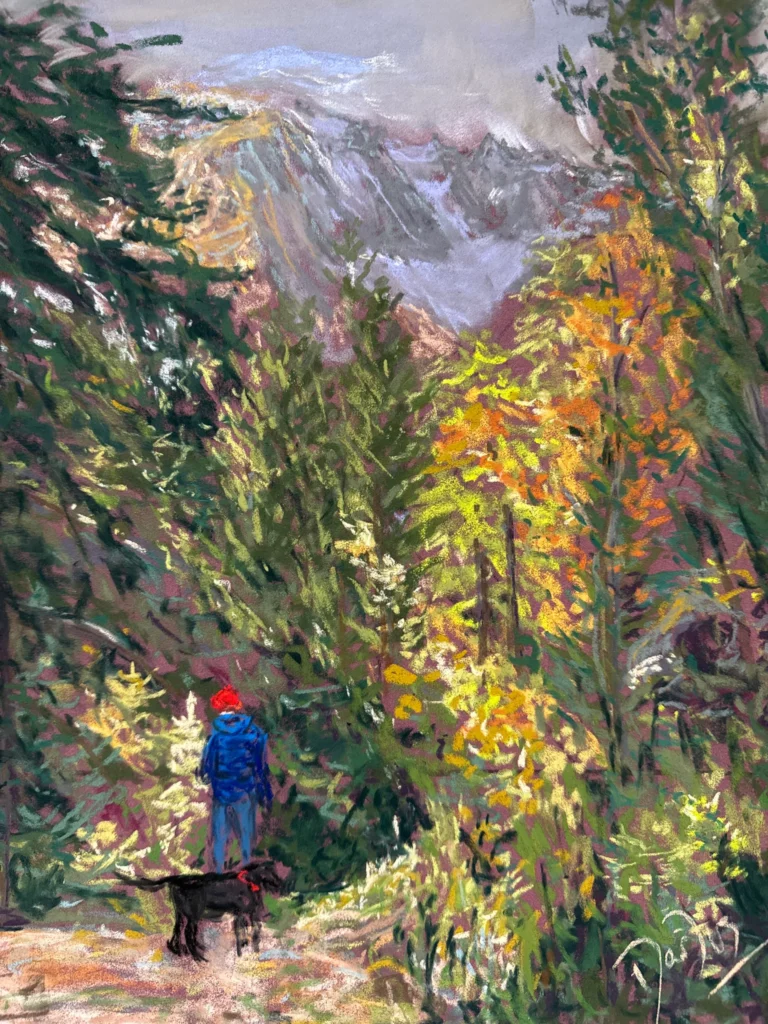
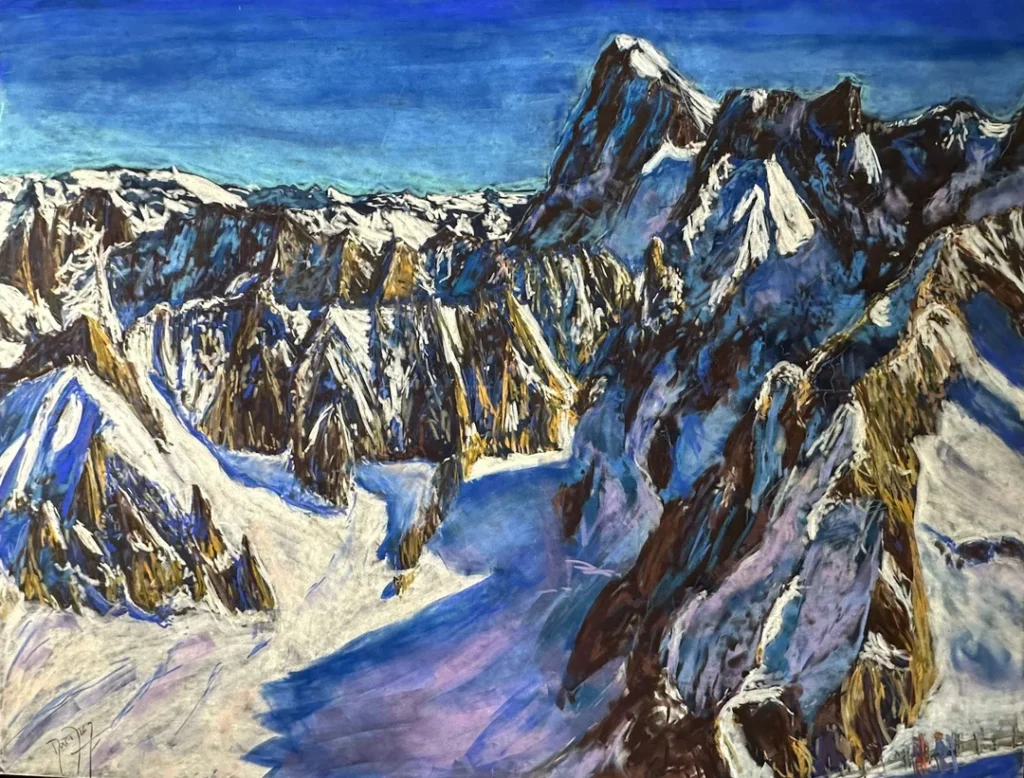
You can go to my shop and see what have been inspiring me lately, lots mountain landscapes in soft pastels, and now in oils too. Go here to check my latest works!
Featured Image: A pair of krapfen at the Friedrich August hut in Val di Fassa. Photo: Rifugio Friedrich August.


Discover more from The-Ski-Guru
Subscribe to get the latest posts sent to your email.
 Subscribe to The-Ski-Guru here.