

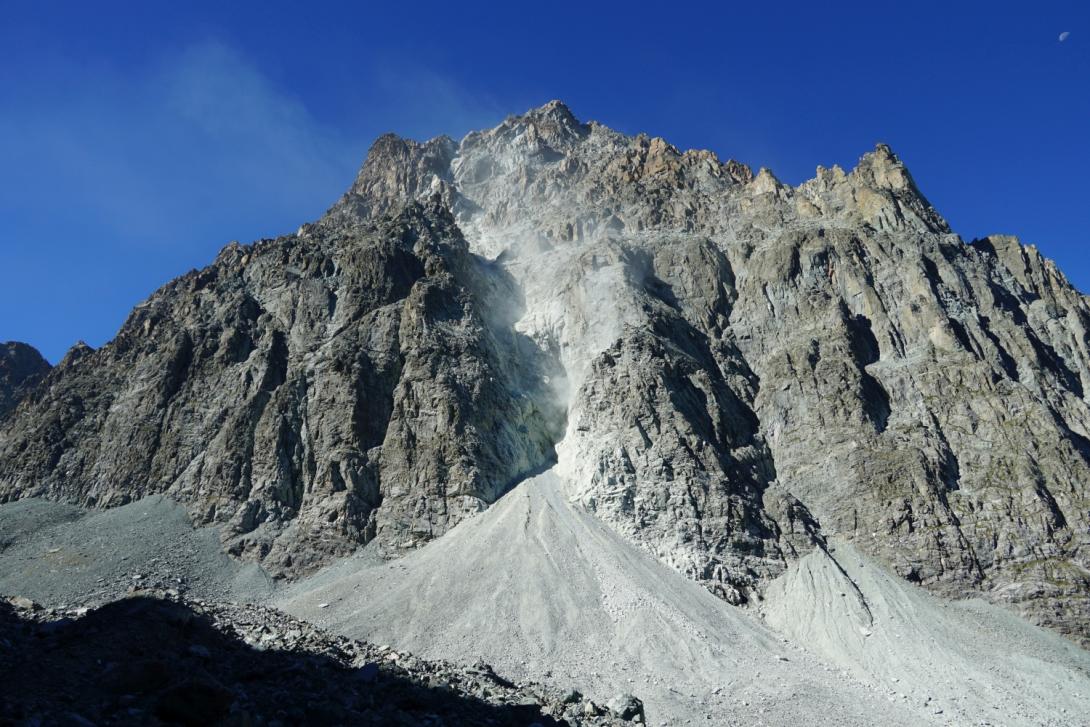
A rockfall on Monviso’s northeast face sent thousands of cubic metres of debris down the mountain on 1 September. No one was injured and the nearby Quintino Sella refuge and its access trail were not hit by the main collapse, but repeated failures on the same face have prompted authorities to examine how the mountain is evolving.
UPDATE — 18 September 2026: New Rockfall and Regional Action
A second significant rockfall on Monviso and new temperature data have prompted the Regione Piemonte to begin a wider assessment of the mountain, including its trails, refuge access and long-term monitoring.
At the first official Tavolo Monviso, held on 16 September, ARPA Piemonte revealed that between 10 June and 10 September temperatures at its monitoring station above 3,300 metres on Monviso did not fall below 0°C.
ARPA identifies thermal stress as a probable factor in the recent rockfalls and degradation of permafrost as a possible contributing factor within a rock mass that is already heavily fractured. However, the agency continues to stress that individual rockfalls need to be assessed on their specific geological and environmental conditions.
The meeting followed another rockfall during the night of 13–14 September, this time from the Torrioni Sari on Monviso’s southern side. Regional authorities say preliminary observations suggest that this event may have been larger than the 1 September collapse on the northeast face, although further surveys are needed to determine its scale.
The two events on different sides of the mountain have led authorities to broaden their assessment from individual rockfall sites to the Monviso massif as a whole.
Access to the mountain is also under review
The Regione Piemonte is now considering additional surveys, including drone inspections, an assessment of the most exposed trails and possible alternative routes to mountain refuges.
One proposal being examined is an alternative access route to the Rifugio Quintino Sella. Improved trail signage and temporary restrictions in particularly exposed areas are also being considered.
This does not currently amount to a general closure or restriction on access to Monviso.
The discussion is also being driven by increasing visitor numbers. According to figures presented at the meeting, around 200 climbers reached the summit during a recent weekend, approximately 40,000 people use the Giro del Viso, and an estimated 200,000 passages are recorded in the wider area around the mountain.
Those figures should not be interpreted as 200,000 people being directly at risk from rockfall. Rather, authorities say the level of use makes it increasingly important to manage visitor flows, improve information and reduce concentrations on the most heavily used routes.
Mountain rescue services have carried out more than 100 interventions in the area over the past three years, with almost half involving people who had lost the trail.
Monitoring rather than alarm
The regional approach remains one of monitoring, prevention and adaptation rather than closing the mountain.
Further technical work will now be carried out by ARPA, universities and research centres. The aim is to produce an initial shared assessment by early spring 2027 covering current knowledge, possible future scenarios and measures that could be adopted.
The Monviso initiative may also become part of a permanent regional forum on the resilience of the Piedmont Alps. A separate assessment of Monte Rosa is due to begin on 22 September.
ARPA says new rockfalls cannot be excluded.
But the evidence presented so far does not support describing Monviso simply as a mountain suddenly “collapsing”. Instead, authorities are investigating how an already highly fractured high-Alpine rock mass is responding to exceptional temperatures, degrading permafrost and other environmental processes — and how access to an increasingly popular mountain should adapt as those conditions change.
A significant rockfall occurred on the northeast face of Monviso in the Italian Alps on the evening of 1 September 2026, triggering a large cloud of dust visible across the area and initially raising concerns for hikers close to the Rifugio Quintino Sella.
Subsequent inspections, however, have provided a much clearer — and less dramatic — picture of what happened.
According to ARPA Piemonte, the regional environmental agency, the collapse began shortly after 8pm above the summit of the Torrione Saint Robert and travelled down the gully below for approximately 1,000 vertical metres.
The material, mostly small- to medium-sized rock fragments with some metre-sized blocks, came to rest on the debris cone at the base of the channel. ARPA estimates that several thousand cubic metres of material were deposited.
Only a minimal proportion of the rock entered the channel facing the Quintino Sella refuge.
The enormous cloud seen in photographs and videos was predominantly dust generated by the collapse. It reached the trail leading to the refuge and coated parts of the surrounding area, but the main body of the rockfall did not reach the trail or the refuge.
No casualties, despite initial concern
The alarm was raised by staff at the Quintino Sella refuge.
Concern increased during the night when a foreign hiker who had been expected at the refuge could not initially be contacted.
A night-time helicopter operated by the regional rescue service reached the area, but the amount of suspended dust and continuing instability prevented rescuers from being lowered onto the mountain.
Checks the following morning established that nobody had been caught in the rockfall, including the missing hiker.
Access along trail V13 between Pian del Re and the Quintino Sella refuge was temporarily suspended as a precaution. The Comune di Crissolo subsequently reopened it after inspections.
The refuge confirmed that the rockfall had not affected the trail itself, nor had it compromised either the Normal Route or the East Ridge climbing routes on Monviso.
The rockfall was not an isolated event
More significant than the dramatic dust cloud is what is happening to the northeast face of Monviso itself.
ARPA’s inspection on 3 September found that small rockfalls were continuing throughout the day.
The agency expects this activity could continue for a prolonged period, as occurred following previous collapses.
ARPA describes the 1 September event as a reactivation of rockfalls that have previously affected the same sector of the mountain. It identified the collapse of 9 August 2023 as particularly similar in both dynamics and volume.
The northeast face has a longer history of instability. Regional authorities have also pointed to a major collapse in December 2019, subsequently studied by ARPA, which identified geological and structural characteristics that make this section of the mountain particularly susceptible to failure.
This distinction matters.
A single rockfall cannot simply be attributed to climate change. High mountain rock faces contain fractures and structural weaknesses and rockfall is a natural geomorphological process.
But warming can influence those already unstable systems.
ARPA scientists had been studying the same face hours earlier
There is an extraordinary coincidence surrounding the latest collapse.
Only hours before it occurred, ARPA technicians and rangers from the Monviso Park had been carrying out observations on the northeast side of the mountain as part of the Carovana dei Ghiacciai campaign.
They identified three major warning signs affecting the Monviso environment.
One concerns the Coolidge Glacier, which has retreated so extensively that it has now been downgraded to a glacionevato— a residual body of perennial snow and ice rather than a functioning glacier.
The second was the frequent rockfall activity affecting the northeast face.
ARPA says these collapses are presumed to be linked, at least in part, to strong warming and the resulting thermal expansion of the rock mass.
The third warning concerned water: the River Po rises at the foot of Monviso, and this summer’s drought has highlighted increasing pressure on water availability downstream.
Just hours after those observations, the northeast face collapsed again.
A wider question: what is happening to Monviso?
The Regione Piemonte has now announced that it will convene a multidisciplinary meeting through its regional climate-change observatory to examine the evolution of Monviso.
ARPA Piemonte, the regional Alpine Rescue service, the Province of Cuneo, territorial authorities, scientists and other institutions are expected to participate.
The objective is not simply to analyse the 1 September rockfall but to combine the available geological and environmental data to understand the broader evolution of the massif and consider possible measures involving monitoring, prevention and safety.
Regional mountain councillor Marco Gallo said the latest collapse forms part of a succession of events affecting Monviso and that authorities want to build a unified picture of what is happening to the mountain.
That may ultimately be the most important story.
Monviso — the distinctive 3,841-metre pyramid often known as the “King of Stone” and one of the most recognisable mountains of the Western Alps — is not suddenly collapsing.
But repeated failures on one of its major faces, continuing rockfall activity, the retreat of its remaining ice and an exceptionally warm summer are giving scientists several changes to watch at the same time.
For now, there were no casualties from the 1 September collapse, the Quintino Sella refuge was not hit and access has been restored.
What scientists and regional authorities conclude about the longer-term evolution of the mountain will be more significant than the spectacular cloud of dust produced by a single rockfall.
This article will be updated when the Regione Piemonte publishes the conclusions of its technical meeting on Monviso.
READ MORE:
- Weisshorn Hanging Glacier Above Randa Raises New Concerns Near Zermatt
https://www.the-ski-guru.com/2026/08/26/weisshorn-hanging-glacier-randa-zermatt/ - Nepal Glacier Disaster: Could Something Similar Happen in the Alps?
https://www.the-ski-guru.com/2026/08/28/nepal-glacier-disaster-alps-risk/ - Planpincieux Glacier Retreat Highlights Rapid Change on Mont Blanc
https://www.the-ski-guru.com/2026/08/25/planpincieux-glacier-retreat-mont-blanc-2026/
Sources
Regione Piemonte — Monviso, prima riunione del Tavolo (16 September 2026) https://www.regione.piemonte.it/web/pinforma/notizie/monviso-cambiamento-climatico-prima-riunione-tavolo-coordinato-dalla-regione
ARPA Piemonte — Il crollo del 1° settembre sul Monviso: esiti dei sopralluoghi Arpa (4 September 2026)
https://www.arpa.piemonte.it/notizia/crollo-1deg-settembre-sul-monviso-esiti-dei-sopralluoghi-arpa
ARPA Piemonte — Crollo dalla parete nordest del Monviso, relazione di approfondimento (29 March 2021)
https://www.arpa.piemonte.it/notizia/crollo-dalla-parete-nordest-monviso-relazione-approfondimento
ARPA Piemonte — Crollo dalla parete nordest del Monviso (16 January 2020)
https://www.arpa.piemonte.it/notizia/crollo-dalla-parete-nordest-monviso
Rifugio Quintino Sella — Ripristino dell’accesso e del transito su sentiero post-frana (2 September 2026)
https://www.rifugiosella.it/ripristino-dell-accesso-e-del-tranisto-su-sentiero-post-frana/
ANSA / Soccorso Alpino — Soccorso alpino, nessuna persona coinvolta nella frana sul Monviso (2 September 2026)
https://www.ansa.it/piemonte/notizie/2026/09/02/soccorso-alpino-nessuna-persona-coinvolta-nella-frana-sul-monviso_900979e8-b817-4318-83a0-a91696605060.html
ANSA — Dopo la frana la Regione Piemonte convoca un tavolo sul Monviso (2 September 2026)
https://www.ansa.it/piemonte/notizie/2026/09/02/dopo-la-frana-la-regione-piemonte-convoca-un-tavolo-sul-monviso_069b8dfd-135e-4338-8f37-4c6d173a9ce1.html
Planning your next trip to the Italian Alps?
If you’re heading to the Aosta Valley, take a look at Il Cuore della Valdigne, our family-owned apartment in Morgex, available for rent when we’re not using it ourselves.
It’s an ideal base to:
- Ski in Courmayeur, La Thuile and Pila
- Enjoy the mountains in summer (hiking, biking, nature)
- Explore the Mont Blanc valley in a quieter, more authentic setting.
Check my Mountain Art on my Shop
You can go to my shop and see what have been inspiring me lately, lots mountain landscapes in soft pastels, and now in oils too. Go here to check my latest works!
Featured Image: Canalone del Monviso. Photo credit: Arpa.Piemonte.it


Discover more from The-Ski-Guru
Subscribe to get the latest posts sent to your email.
 Subscribe to The-Ski-Guru here.
You must be logged in to post a comment.