

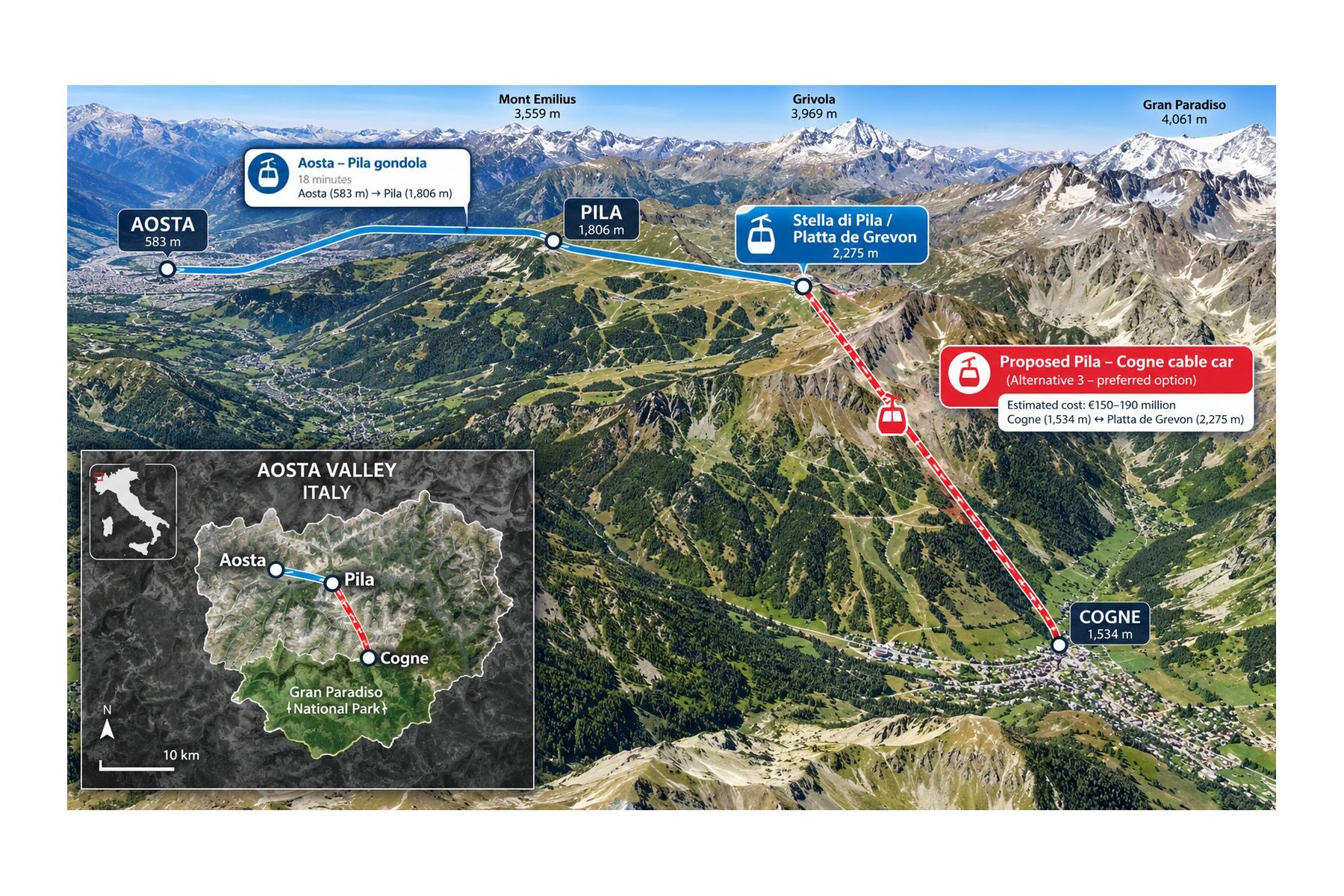
A long-discussed cable-car connection between Pila and Cogne in Italy’s Aosta Valley has taken another step forward, with three possible routes now emerging from an initial nine alternatives — and one identified by the technical study as the preferred option.
If eventually built, the project could create something much bigger than a new ski lift. By connecting Cogne with Pila, which is already linked directly by gondola to the city of Aosta, it could effectively create an integrated Aosta–Pila–Cogne mountain destination, combining a regional capital, an alpine ski resort and one of the best-known gateways to the Gran Paradiso National Park.
But this is important: the cable car has not yet been approved for construction.
The latest step concerns the technical feasibility study, while the project is now entering a political and public consultation phase before decisions are made on whether to proceed.
Nine alternatives reduced to three
The project was examined by the Aosta Valley Regional Council’s Economic Development Commission on 1 October 2026.
The technical team initially considered nine different alternatives for connecting Cogne with the Pila ski area.
Three have now been identified as the most practicable solutions, all connecting Cogne with the area of Platta de Grevon, high above Pila.
According to local newspaper AostaSera, the technical analysis currently places Alternative 3 as the most favourable of the options considered.
The assessment is not simply based on construction cost. The feasibility document compares the alternatives against 33 different criteria, including technical feasibility and territorial constraints.
One of the issues that has had to be considered is the presence of the very-high-voltage trans-Alpine electricity infrastructure crossing the area.
The study presented to the Regional Council is therefore not a final construction project, but a DOCFAP — Documento di Fattibilità delle Alternative Progettuali, effectively a feasibility assessment comparing the possible solutions.
How much could the Pila–Cogne cable car cost?
And this would be a major investment.
AostaSera reports an estimated cost of approximately €150 million to €190 million, depending on the final solution and specifications.
RAI TGR Valle d’Aosta reported a slightly broader estimated range of approximately €130 million to €190 millionfollowing the Commission meeting.
At this stage, however, there is no final construction budget and regional participation in financing the project remains subject to further assessment.
That distinction matters. The project is progressing through the planning process, but funding for construction has not yet been approved.
When could it be built?
If the political process ultimately gives the project the green light, this would still be a medium-term development rather than a new lift opening in the immediate future.
According to the timetable reported by AostaSera, Pila Spa envisages approximately:
- two years for the design and planning process, followed by
- two to three years of construction.
That potentially puts the project several years away even under a relatively smooth approval process.
Environmental assessments, authorisations, detailed engineering and financing would all still have to be dealt with before construction could begin.
From Aosta to Cogne via Pila
What makes the proposal particularly interesting from a tourism perspective is the geography.
Pila is already directly connected with Aosta, the regional capital, by gondola.
At the upper end of the ski area, Pila has also invested heavily in its new high-altitude infrastructure towards Couis and Platta de Grevon, including the new Stella di Pila development.
A connection over the mountain to Cogne would therefore not exist in isolation.
It would potentially create a continuous lift-assisted axis:
Aosta → Pila → Platta de Grevon → Cogne
That could significantly change how visitors move around this part of the Aosta Valley.
Rather than Cogne being reached almost exclusively along its road valley, visitors could potentially arrive from Aosta through Pila without using a car.
For international visitors in particular, the concept is interesting because Aosta has rail and road connections with the rest of the region, while the Aosta–Pila gondola starts close to the city centre.
It is not just about skiing
It would be easy to describe the proposal simply as an expansion of the Pila ski area, but that does not fully explain its potential significance.
Cogne and Pila are very different destinations.
Pila is primarily known as an alpine ski resort, with direct access from Aosta and a developing summer mountain product.
Cogne has its own small downhill ski area but is internationally better known for cross-country skiing, hiking, nature, ice climbing and the Gran Paradiso National Park.
The possible connection therefore raises the prospect of combining two complementary tourism products rather than merely adding kilometres of pistes.
In winter, visitors staying in Cogne could potentially access Pila’s larger alpine ski area without driving.
Visitors staying in Pila or Aosta could travel in the opposite direction for cross-country skiing, winter walking or a day in Cogne.
And the implications could arguably be even more interesting outside the ski season.
Cogne is one of the Aosta Valley’s strongest summer mountain destinations, while Pila has been developing mountain biking and other warm-season activities.
A lift connection could consequently become part of a four-season mountain mobility system, rather than an infrastructure used exclusively by skiers.
The 2024 floods changed the discussion
There is another reason why the idea of an alternative connection to Cogne has attracted attention.
In June 2024, severe flooding and landslides cut the road connection to Cogne, temporarily isolating the valley.
That event renewed discussion about whether Cogne should have an alternative means of access.
The proposed cable car has subsequently appeared in political discussions both as tourism infrastructure and as a possible additional connection.
However, opponents have questioned how useful a cable car could really be during severe weather events, pointing out that lift infrastructure can itself be affected by wind and extreme conditions and cannot replace a road for vehicles, freight or emergency traffic.
So while resilience has become part of the argument surrounding the project, the proposed cable car should not be interpreted as a straightforward substitute for Cogne’s road access.
Not everyone in Cogne is convinced
The project has also generated a significant local debate.
An initial public presentation in Cogne in February 2026 attracted more than 200 people, when the nine alternatives were explained and participants discussed their possible advantages and disadvantages.
Issues raised included the potential effects on tourism, the landscape, the environment and Cogne’s property market.
Later, 191 signatures were collected asking for greater information and public involvement in the decision-making process.
Some residents and environmental groups have questioned whether such a major piece of infrastructure is compatible with Cogne’s identity and its position alongside the Gran Paradiso National Park.
Legambiente Valle d’Aosta has also raised concerns about environmental impacts and the scale of the proposed development.
Supporters, meanwhile, see the link as an opportunity to improve sustainable mobility, reduce dependence on cars and strengthen Cogne’s connection with Pila and Aosta.
This debate is therefore far from over.
The discussion echoes another long-running Aosta Valley lift-link controversy, the proposed Cime Bianche connection
What happens next?
The 1 October meeting did not give the project a final green light.
Instead, it effectively moved the proposal from the technical assessment stage towards the political decision-making stage.
Regional Economic Development Commission president Josette Borre said further hearings would involve the municipalities concerned, associations and the people behind the petition presented in Cogne.
Regional Economic Development and Transport Councillor Luigi Bertschy has also said the next phase will involve political groups, local administrations and citizens before decisions are made on whether to continue the design process and, subsequently, whether to proceed with the investment.
That means there are still several important questions to answer:
- Which of the three remaining routes will ultimately be selected?
- What will the final environmental impact be?
- How much will the project actually cost?
- How would it be financed?
- How would the connection operate in summer as well as winter?
- And, perhaps most importantly, what kind of tourism model does Cogne want for the coming decades?
A potentially transformative project for the Aosta Valley
The scale of the proposal makes the Pila–Cogne link one of the more interesting mountain transport projects currently being discussed in the Alps.
If it proceeds, its importance would go beyond connecting two ski areas.
It could effectively connect Aosta’s historic city centre, the ski slopes and summer trails of Pila, and Cogne’s Gran Paradiso mountain environment through a largely lift-based public transport and tourism corridor.
That could be particularly attractive as Alpine destinations increasingly look at reducing car dependency and developing year-round tourism.
But with an estimated investment potentially approaching €200 million, major environmental considerations and an active debate within Cogne itself, there is still a considerable distance between a preferred feasibility option and a completed cable car.
For now, the most significant development is that nine theoretical alternatives have become three realistic ones — and the Aosta Valley must now decide whether it wants to take the next step.
The-Ski-Guru will follow the Pila–Cogne project as the preferred route, financing and approval process become clearer.
Read More
More on the proposed Pila–Cogne connection
- Aosta Backs Inter-Valley Link Between Pila and Cogne
- Cogne–Pila Cable Car: Environmental and Economic Impact
- Cogne–Pila Cable Car Debate Grows in the Aosta Valley
Explore Pila, Cogne and the Aosta Valley
- Must-Read Guide to Pila, Aosta Valley
- Aosta, Italy: Complete Guide to the Alpine City
- Where to Cross-Country Ski in the Aosta Valley
Another major Aosta Valley lift-link debate
Sources
AostaSera — Funivia Pila-Cogne, si scartano le ipotesi. La più “papabile” è l’alternativa numero tre — 1 October 2026. Aostasera
RAI TGR Valle d’Aosta — Collegamento Pila-Cogne in Commissione — 1 October 2026. RaiNews
ANSA Valle d’Aosta — Collegamento Pila-Cogne in commissione, si apre il confronto politico — 1 October 2026. ANSA.it
Gazzetta Matin — Funivia Cogne-Pila: presentate 9 alternative per il collegamento intervallivo — 5 February 2026. This is the report on the public meeting in Cogne attended by more than 200 people.

Planning your next trip to the Italian Alps?
If you’re heading to the Aosta Valley, take a look at Il Cuore della Valdigne, our family-owned apartment in Morgex, available for rent when we’re not using it ourselves.
It’s an ideal base to:
- Ski in Courmayeur, La Thuile and Pila
- Enjoy the mountains in summer (hiking, biking, nature)
- Explore the Mont Blanc valley in a quieter, more authentic setting.
Check my Mountain Art on my Shop
You can go to my shop and see what have been inspiring me lately, lots mountain landscapes in soft pastels, and now in oils too. Go here to check my latest works!

Featured Image: The proposed Pila–Cogne cable car would connect Cogne with Platta de Grevon/Stella di Pila, creating a potential lift-linked route through Pila to Aosta. Illustration: The-Ski-Guru.


Discover more from The-Ski-Guru
Subscribe to get the latest posts sent to your email.
 Subscribe to The-Ski-Guru here.
You must be logged in to post a comment.