
Italian police have searched companies linked to the Apollonio–Socrepes cable car in Cortina d’Ampezzo, one of the most controversial infrastructure projects connected to the Milano-Cortina 2026 Winter Olympics.
According to Reuters, searches were carried out at Simico, the state-backed Olympic infrastructure agency, and Graffer, the company responsible for building the lift, as part of a bid-rigging investigation linked to the cable car contract. Prosecutors said searches also took place in several Italian cities, including Rome, Milan, Brescia, Naples and Cortina. Simico has said it is cooperating fully with prosecutors and is confident it acted correctly, while Graffer did not immediately respond to Reuters’ request for comment.
The investigation does not mean guilt has been established. At this stage, the case concerns allegations and investigative hypotheses, and any responsibility would need to be proven through the legal process.
Italian media have reported that three people are under investigation, including Simico CEO Fabio Massimo Saldini. ANSA described the prosecutor’s hypothesis as “turbata libertà di gara d’appalto”, which refers to alleged interference with the fairness of a public tender process. The Italian infrastructure ministry has said it is confident that the rules were respected.
Why This Cable Car Matters
The Apollonio–Socrepes cable car was intended to improve access between Cortina and the Tofane area, where women’s Alpine skiing events were held during the Milano-Cortina 2026 Winter Olympics. It was not just a local lift project, but part of the wider Olympic mobility plan for a town with limited access, no railway station, and long-standing traffic bottlenecks.
Reuters had already reported before the Games that the lift would not be ready in time for the start of the Olympics. The delay forced organisers to rely more heavily on shuttle buses and traffic restrictions, while ticket sales for some Cortina events had already been capped because of transport concerns.
That makes the current investigation more than a procurement story. It touches on a wider question facing many mountain destinations: how quickly, safely and transparently can major infrastructure be delivered when political deadlines, visitor flows, fragile terrain and public money all converge?
This is also why the Cortina case fits into the broader pattern discussed in Mountain Infrastructure Risk in the Alps. Large projects in alpine terrain are rarely only engineering questions. They involve geology, access, environmental risk, local opposition, public funding, tourism pressure and, in this case, Olympic deadlines.
From Olympic Deadline to Legal Scrutiny
The Apollonio–Socrepes project had already attracted attention because of delays and concerns linked to the site. Reuters reported in January that the cable car was being built in an area described as landslide-prone, and that residents had raised safety concerns while construction was still unfinished shortly before the Games.
By the time police searches were carried out in May 2026, the cable car had already become a symbol of the pressures surrounding Milano-Cortina 2026 infrastructure. The Games were spread across several locations in northern Italy, placing particular pressure on transport planning. Cortina, with its narrow valley access and no direct rail connection, was always one of the most sensitive locations.
For ski resorts and mountain towns, the key issue is not whether new lift infrastructure is needed. In many cases, it is. Modern lifts can reduce road congestion, improve visitor flow, and help resorts manage demand more efficiently. The real question is how these projects are planned, contracted, communicated and delivered.
This is where Cortina now becomes a useful case study alongside other alpine infrastructure debates, including Courmayeur’s New Gondolas Reflect a Shift in Alpine Infrastructure. Across the Alps, resorts are trying to modernise lift systems while facing rising scrutiny over public spending, environmental impact, construction timelines and long-term usefulness beyond peak events.
A Wider Warning for Olympic and Alpine Infrastructure
The Cortina investigation comes after months of attention on whether Olympic infrastructure would be delivered on time, and whether some projects were being pushed too close to the deadline. Reuters reported in November 2025 that transport concerns in Cortina had already forced a reduction in ticket availability for Olympic events, with the delayed gondola a central factor in those concerns.
This does not mean that every delayed mountain project points to wrongdoing. Alpine construction is difficult. Weather, terrain, permitting, geological instability, environmental constraints and local legal challenges can all slow delivery. But when major public projects are connected to mega-events, the risks are amplified. Timelines become tighter, political pressure increases, and decisions that might normally take years are pushed through under exceptional circumstances.
For mountain destinations, that should matter beyond the Olympics. Ski resorts increasingly need to invest in transport, lifts, snowmaking, slope protection, water storage, and climate adaptation. Those investments are often expensive and highly visible. They also take place in landscapes where mistakes can have long-term consequences.
That is why the Cortina case also connects with Snow Conditions in a Warming Alpine Climate. As climate pressure increases, resorts and public authorities will need to spend more on infrastructure. But the higher the pressure to adapt, the more important transparency and long-term planning become.
What Happens Next?
The next important developments will be whether prosecutors move from searches and preliminary investigations to formal charges, whether Simico or Graffer issue fuller public statements, and whether new details emerge about how the contract was awarded.
For now, the most responsible way to read this story is as part of a broader pattern. The Apollonio–Socrepes cable car was already under scrutiny because it was late, expensive, politically sensitive and central to Olympic mobility in Cortina. The bid-rigging investigation adds another layer, but the deeper question is not only legal. It is about how alpine destinations manage major infrastructure when event deadlines and mountain realities collide.
For Cortina, the issue is particularly sensitive because the Olympics were supposed to leave a long-term mobility legacy. Whether the Apollonio–Socrepes cable car ultimately delivers that legacy will now be judged not only by whether the lift operates, but also by how the project was planned, awarded and delivered.
Sources
Reuters — Italian police search firms over Olympic cable car contract
https://www.reuters.com/business/italian-police-search-firms-over-olympic-cable-car-contract-2026-05-21/
ANSA — La procura: “Truccato l’appalto per la cabinovia olimpica di Cortina”
https://www.ansa.it/sito/notizie/cronaca/2026/05/21/la-procura-truccato-lappalto-per-la-cabinovia-olimpica-di-cortina_a1550696-636f-48b3-87d0-3abb05b98566.html
ANSA English — Probe into Cortina Olympic cable car opened
https://www.ansa.it/english/news/sports/2026/05/21/probe-into-cortina-olympic-cable-car-opened_076f8434-3f09-46c2-8fd5-de3a8ec1f695.html
Reuters — Cortina cable car will not be ready in time for Winter Games start
https://www.reuters.com/sports/cortina-cable-car-will-not-be-ready-time-winter-games-start-letter-shows-2026-01-31/
Reuters — Transport fears force cap on ticket sales for events in Italy’s Cortina
https://www.reuters.com/sports/transport-fears-force-cap-ticket-sales-events-italys-cortina-2025-11-27/
Le Monde — 2026 Winter Olympics: New infrastructure raises financial and environmental questions
https://www.lemonde.fr/en/environment/article/2026/02/22/2026-winter-olympics-new-infrastructure-raises-financial-and-environmental-questions_6750752_114.html
 Planning your next trip to the Italian Alps?
 Planning your next trip to the Italian Alps?
If you’re heading to the Aosta Valley, take a look at Il Cuore della Valdigne, our family-owned apartment in Morgex, available for rent when we’re not using it ourselves.
It’s an ideal base to:
- Ski in Courmayeur, La Thuile and Pila
- Enjoy the mountains in summer (hiking, biking, nature)
- Explore the Mont Blanc valley in a quieter, more authentic setting.
 Ski in Courmayeur,
 Enjoy the mountains in summer (hiking, biking, nature)
Check my Mountain Art on my Shop
You can go to my shop and see what have been inspiring me lately, lots mountain landscapes in soft pastels, and now in oils too. Go here to check my latest works!
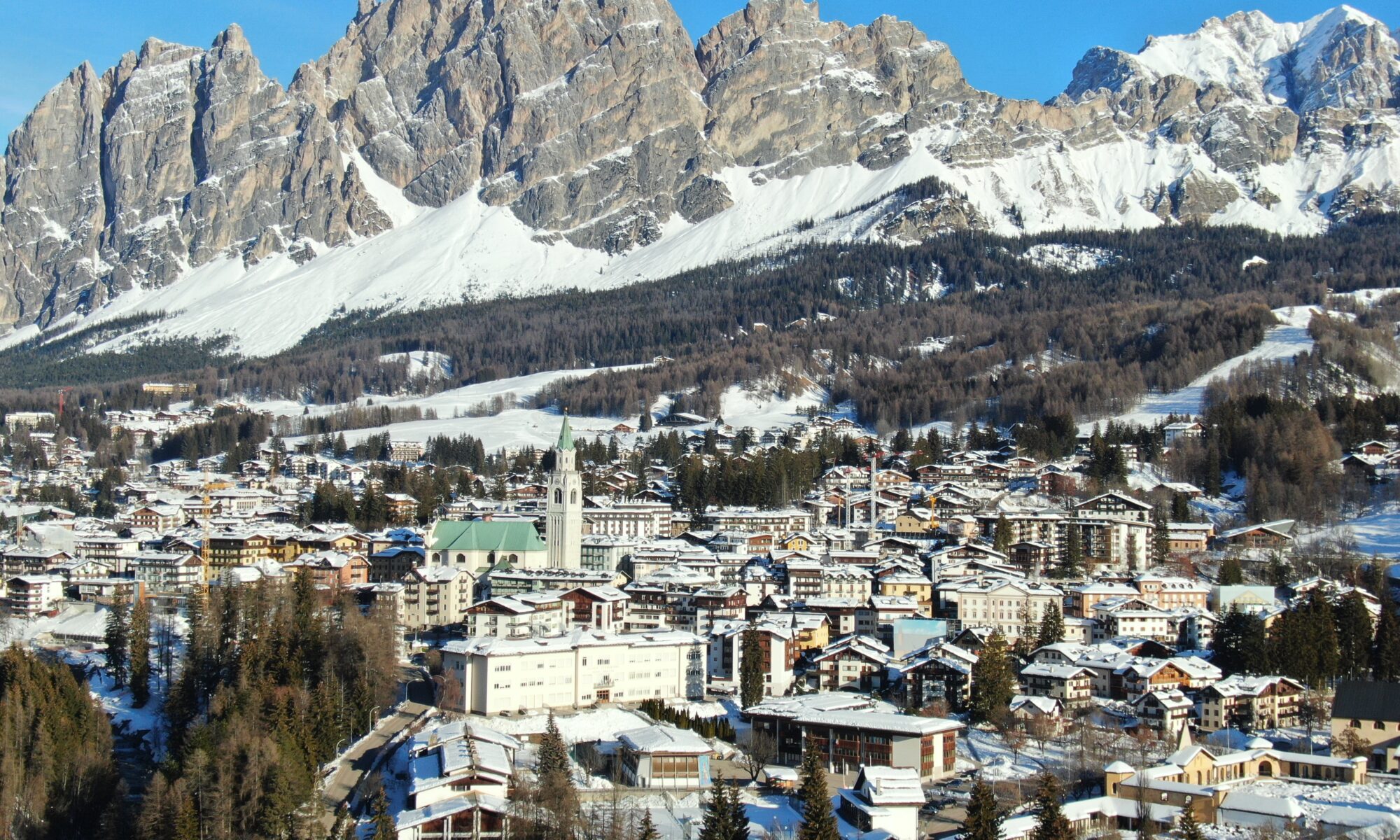
Featured Image: Cortina d’Ampezzo. Photo credit: Pietro Albarelli. Cortina Marketing.


Discover more from The-Ski-Guru
Subscribe to get the latest posts sent to your email.
 Subscribe to The-Ski-Guru here.