

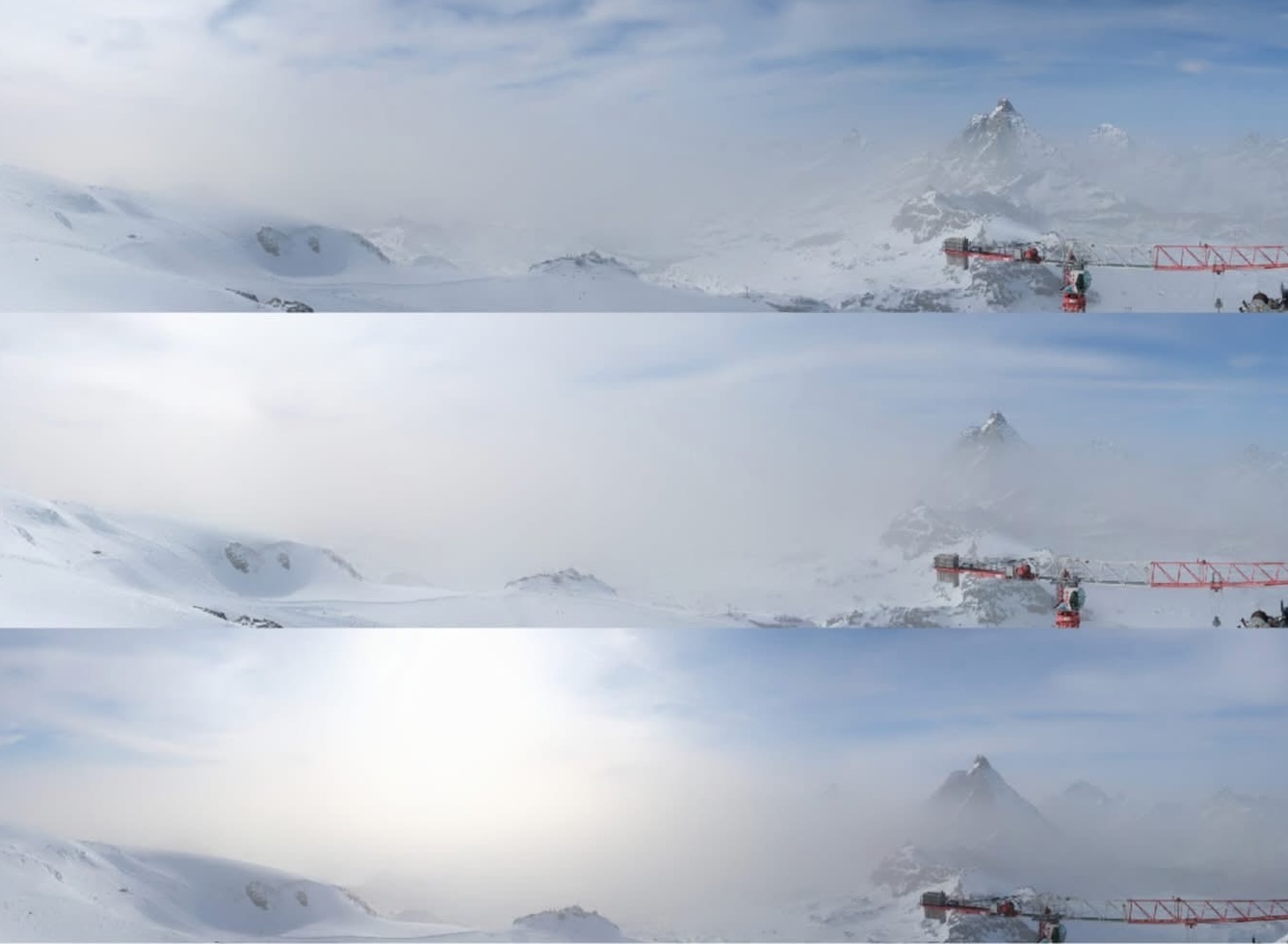
A hazy sky observed across parts of the Aosta Valley and the wider Alps in early March has an unusual origin: Saharan dust transported north across the Mediterranean.
Meteorological observations indicate that large quantities of fine sand particles from the Sahara Desert have been carried into Alpine air masses during a prolonged period of high pressure.
Similar Saharan dust events have been documented by atmospheric monitoring services across Europe, including observations from the Copernicus Atmosphere Monitoring Service, which regularly tracks large dust plumes transported from North Africa into the Mediterranean and Alpine regions. These atmospheric events can influence visibility, air quality and — when dust settles on snow surfaces — the evolution of the mountain snowpack.
The result has been a visible veil of haze in the atmosphere and dust deposition on snow surfaces at high altitude, something that can have important consequences for the evolution of the snowpack.
Webcam images from Piccolo Cervino (3883 m), above Breuil-Cervinia, show the progressive increase of dust suspended in the air during the day.
Meteorologists across the region also report exceptionally mild temperatures for the time of year, with freezing levels remaining unusually high for several consecutive days.
These episodes are part of a broader pattern of extreme weather in the Alps, affecting snow quality and melt rates.
Similar patterns are now visible beyond the Alps, where extreme heat has forced early resort closures in North America.
Temperatures More Typical of Late Spring
According to high-altitude measurements in the Matterhorn region:
- −1.1°C maximum recorded at 3130 m (Bontadini station near Cervinia)
- −3.2°C recorded at 3467 m at Plateau Rosa
These values are far milder than typical early-March conditions, resembling temperatures more commonly seen in late April or early May.
For roughly two weeks, the Alpine region has been experiencing a persistent mild phase, with the freezing level frequently remaining above 3000 metres.
Under these conditions the snowpack begins transitioning earlier toward spring melt cycles, particularly at mid-elevations.
Saharan Dust and the Snow Albedo Effect
Saharan dust intrusions into the Alps occur several times each winter or spring, typically when southern airflows transport dust northward from North Africa.
The dust has an important physical impact on the snow surface.
Fresh snow reflects most incoming solar radiation due to its high albedo. When dust settles on the surface, however, the snow becomes darker and absorbs more heat.
This can lead to:
- faster daytime warming of the snow surface
- earlier onset of melting during sunny periods
- increased meltwater penetration into the snowpack
As a result, snowmelt can accelerate even without significant increases in air temperature.
What This Means for Avalanche Conditions
These processes are part of the broader snowpack evolution observed this winter across the Alps. Several incidents earlier in the season were documented during the February 2026 avalanche cycle across the Alps
https://www.the-ski-guru.com/2026/02/24/february-2026-avalanche-cycle-alps/
That period saw heavy snowfall followed by warming, creating widespread instability across multiple mountain regions.
Even without new snowfall, these conditions can influence avalanche activity.
As surface snow warms and meltwater percolates through the snowpack, several types of instability may develop:
• Wet loose avalanches
• Wet slab avalanches
• Glide avalanches
These avalanche types are commonly associated with spring warming. You can read more about how they form in our guide to wet avalanches in spring in the Alps:
https://www.the-ski-guru.com/2026/03/07/wet-avalanches-spring-alps/
These typically become more likely:
• on south-facing slopes
• at mid-elevations where daytime temperatures rise above freezing
• during afternoon warming periods
This evolving situation fits within the broader late-winter snowpack transition currently being observed across the Alps.
👉 Avalanche safety guide:
Understanding Level 3 Avalanche Danger (Considerable)
https://www.the-ski-guru.com/2026/02/21/avalanche-danger-level-3/
👉 Avalanche safety guide:
Understanding Level 4 Avalanche Danger (High)
https://www.the-ski-guru.com/2026/02/21/avalanche-danger-level-4/
These guides explain how warming cycles and structural weaknesses in the snowpack can lead to increased avalanche instability.
A Late-Winter Transition Toward Spring Snowpack Dynamics
While winter conditions remain at high elevations, the current weather pattern highlights how rapidly Alpine snowpacks can evolve.
Following periods of heavy snowfall earlier in the season, warming temperatures and dust deposition can accelerate the shift toward spring snow behaviour, where temperature becomes a dominant driver of instability.
For skiers, mountaineers and backcountry travellers, monitoring daily avalanche bulletins and temperature trends becomes increasingly important during these transitional periods.
FAQ – Saharan Dust and Avalanche Risk in the Alps
Why does Saharan dust reach the Alps?
Dust from the Sahara can travel thousands of kilometres when strong southern airflows transport particles across the Mediterranean into Europe. These events are relatively common in spring and early summer.
Does Saharan dust increase avalanche risk?
Indirectly, yes. Dust deposited on snow darkens the surface, reducing reflectivity and allowing the snow to absorb more solar radiation. This can accelerate melting and contribute to wet avalanche conditions.
What types of avalanches are linked to warm temperatures?
During warming periods the most common avalanche types include:
- wet loose avalanches
- wet slab avalanches
- glide avalanches
These usually occur later in the day when solar heating and meltwater weaken the snowpack.
Is Saharan dust visible on the snow?
Yes. After deposition the snow surface may appear yellow, orange, or brownish, particularly after fresh snowfall partially buries the dust layer.
These layers can also become persistent markers within the snowpack, sometimes influencing later snow stability.
Sources
• Meteo Valle d’Aosta – Regional Weather Service
Webcam observations and meteorological analysis of dust transport and high freezing levels in the Aosta Valley.
https://www.meteo.vda.it
• Copernicus Atmosphere Monitoring Service – Saharan Dust Over Europe
Explanation of how Saharan dust plumes travel across the Mediterranean and reach European mountain regions including the Alps.
https://atmosphere.copernicus.eu/saharan-dust-colours-skies-and-snow
• Di Mauro et al. – Saharan Dust Events in the European Alps (Cryosphere Journal)
Scientific research explaining how dust deposited on snow reduces reflectivity (albedo) and accelerates snowmelt in mountain regions.
https://tc.copernicus.org/articles/13/1147/2019/
• Euronews – Saharan Dust Cloud Reaches Europe
Overview of recent Saharan dust plumes affecting skies across parts of Europe and the Mediterranean region.
https://www.euronews.com/2026/03/04/why-are-europes-skies-turning-orange-a-massive-saharan-dust-cloud-is-on-the-way
These institutions monitor weather patterns, snowpack evolution and avalanche conditions across the Alpine region.
 Planning your next trip to the Italian Alps?
 Planning your next trip to the Italian Alps?
If you’re heading to the Aosta Valley, take a look at Il Cuore della Valdigne, our family-owned apartment in Morgex, available for rent when we’re not using it ourselves.
It’s an ideal base to:
- Ski in Courmayeur, La Thuile and Pila
- Enjoy the mountains in summer (hiking, biking, nature)
- Explore the Mont Blanc valley in a quieter, more authentic setting.
 Ski in Courmayeur,
 Enjoy the mountains in summer (hiking, biking, nature)
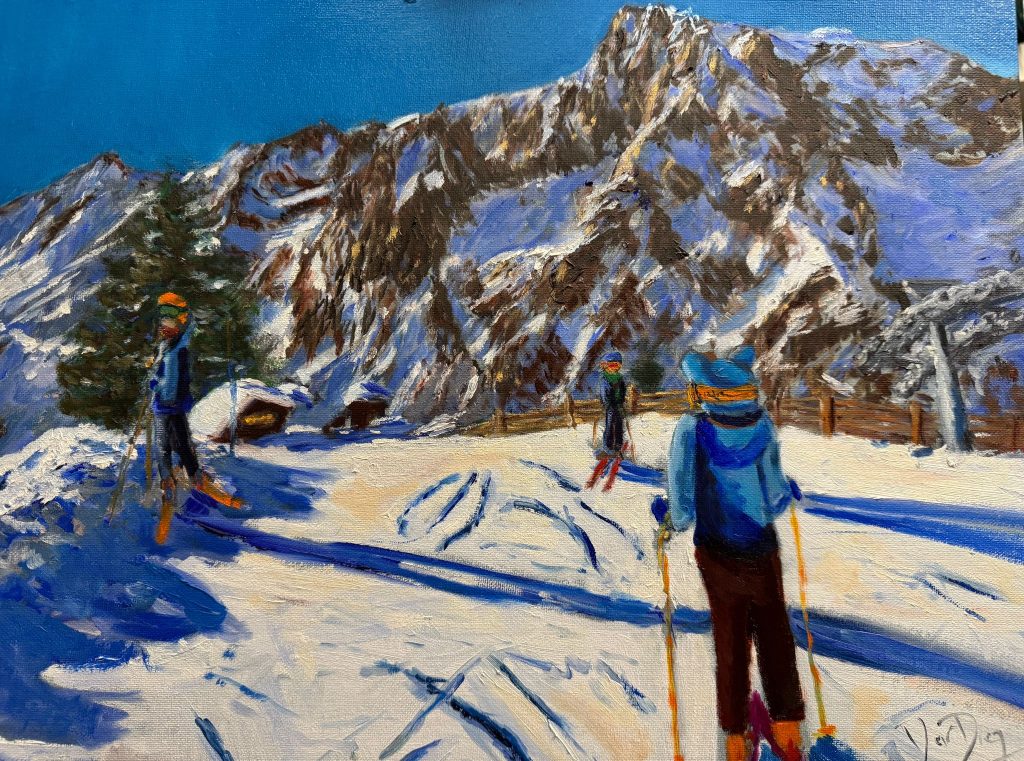
Check my Mountain Art on my Shop
You can go to my shop and see what have been inspiring me lately, lots mountain landscapes in soft pastels, and now in oils too. Go here to check my latest works!
Featured Image:
Saharan dust transported from North Africa visible above the Alps near Cervinia. Source: Meteo Valle d’Aosta webcam.


Discover more from The-Ski-Guru
Subscribe to get the latest posts sent to your email.
 Subscribe to The-Ski-Guru here.