

Extreme heat is continuing to disrupt the high Alps, forcing the suspension of summer skiing, closing a mountain refuge at more than 3,600 metres and coinciding with further rockfalls in the Dolomites.
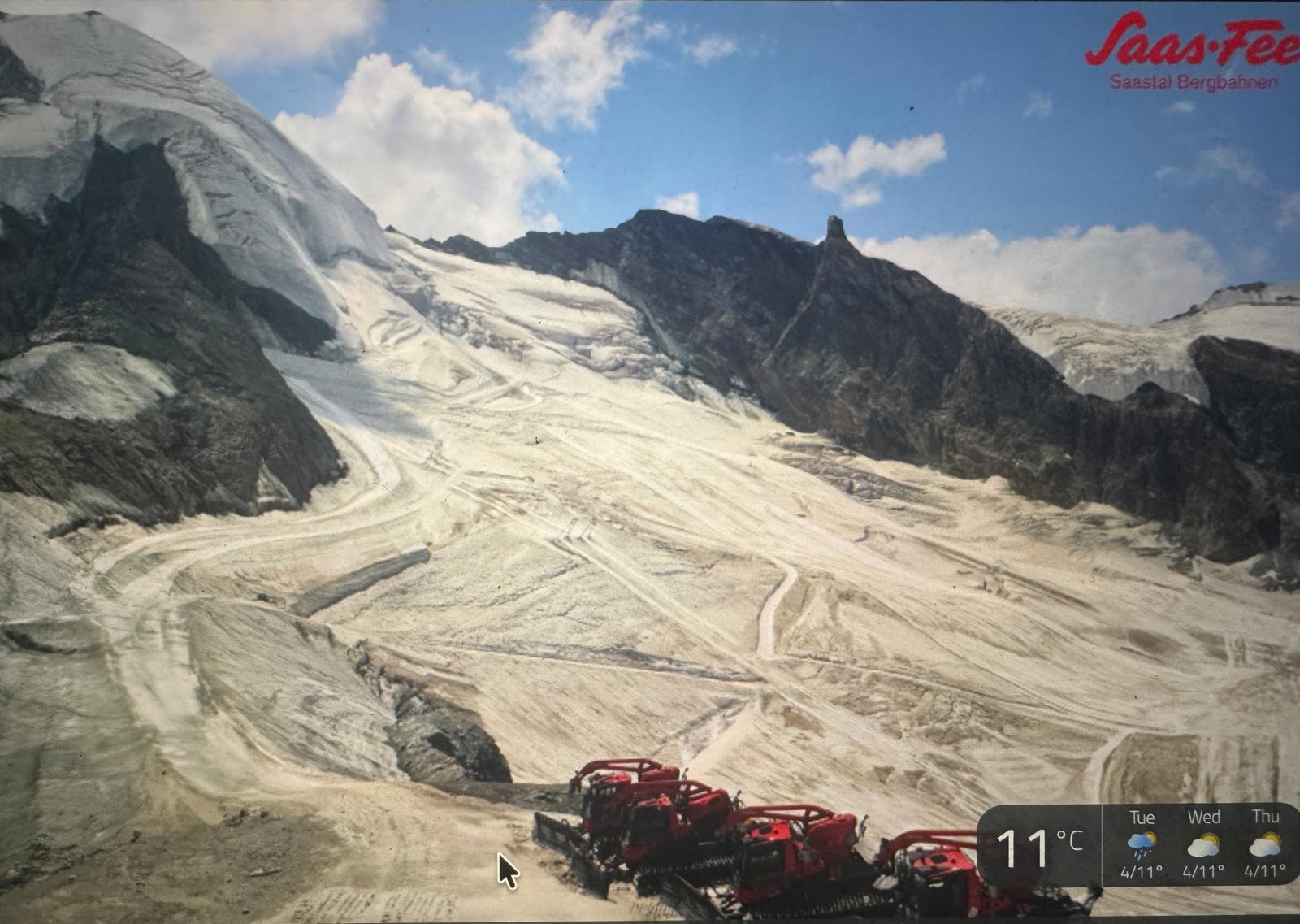
Saas-Fee has suspended summer skiing from Monday, August 10, becoming the latest major Alpine glacier ski area affected by persistently high temperatures and deteriorating snow and glacier conditions.
The Swiss resort follows Zermatt, which had already suspended public summer skiing on the Theodul Glacier. On the Bernina massif in Italy, the Marco e Rosa refuge has closed as exceptionally warm conditions make the surrounding high mountain increasingly dangerous.
And on Sunday, August 9, another significant rockfall occurred on Monte Pelmo in the Dolomites, producing a large cloud of dust visible from the valley below.
The developments come as another intense heatwave affects Italy and the Alpine region, with temperatures approaching 40°C in parts of the country.
Together, they provide another striking illustration of how the exceptionally hot summer of 2026 is affecting glaciers, mountaineering routes and high-altitude activities across the Alps.
Saas-Fee Suspends Summer Skiing
Saas-Fee had planned to operate summer skiing on the Fee Glacier from July 18, with skiing during the warmest part of the season generally restricted to the morning.
Those plans have now been interrupted.
Summer skiing has been suspended from August 10 because of high temperatures and changing snow and glacier conditions. The suspension is temporary, with conditions continuing to be monitored.
The decision is particularly significant because Saas-Fee is one of Europe’s best-known summer ski training centres.
Its high-altitude glacier terrain above 3,000 metres is regularly used by national ski teams, race academies and professional athletes preparing for the northern hemisphere winter.
Other summer mountain activities in Saas-Fee are separate from the glacier ski operation, so visitors should check current lift and activity information directly with the resort before travelling.
Read more: Nepal Glacier Disaster: Could It Happen in the Alps? — After the catastrophic glacier-related collapse in Nepal, we compare Himalayan and Alpine hazards, including Blatten, Planpincieux, Tête Rousse and Courmayeur’s history of extreme mountain events.
Zermatt and Cervinia Were Already Affected
The Saas-Fee suspension follows the decision in neighbouring Zermatt to stop public summer skiing on the Theodul Glacier.
Exceptionally warm conditions have made maintaining suitable skiing conditions on the glacier increasingly difficult.
The decision also affects the summer ski product marketed from Cervinia.
Although Cervinia and Zermatt sit on opposite sides of the Italian-Swiss border, their high-altitude ski areas are interconnected, with summer skiing accessed through the glacier terrain above Zermatt.
This should not be confused with the international sightseeing connection.
The Matterhorn Alpine Crossing and other lift operations linking Cervinia and Zermatt are separate from the summer ski slopes and may continue to operate even when glacier skiing is suspended.
With both Zermatt and Saas-Fee suspending summer skiing, however, the number of Alpine areas able to offer lift-served skiing during the hottest weeks of summer has become increasingly limited.
Extreme Heat Closes a Refuge at 3,609 Metres
The effects of the heat are not confined to skiing.
On the Bernina massif, the Marco e Rosa De Marchi–Agostino Rocca refuge has been forced to close because exceptionally warm conditions have made the surrounding mountain and its access routes increasingly dangerous.
The refuge stands at 3,609 metres, making its closure particularly striking.
The Valtellina section of the Italian Alpine Club, CAI, which owns the refuge, announced its immediate closure after assessing the situation with the hut manager.
Giancarlo Bianco Lenatti, who has managed the refuge for around three decades, told Italian media that he had never experienced conditions like these.
Rock and ice falls have been observed near the refuge as normally frozen terrain becomes increasingly unstable.
Conditions on the approaches have also deteriorated. Large openings and crevasses have appeared in snow and ice at lower elevations, while routes approaching the Bernina from the Swiss side have also been affected by safety restrictions.
The situation demonstrates how the consequences of prolonged warmth can extend to altitudes well above 3,000 metres, affecting not only glaciers but also climbing routes and access to some of the Alps’ highest refuges.
Another Major Rockfall on Monte Pelmo
Instability is also being reported further east in the Dolomites.
On Sunday, August 9, a significant rockfall occurred on Monte Pelmo above Val di Zoldo.
The collapse, reported at around 17:15, produced a loud roar and a large cloud of dust that could be seen from the surrounding valley.
Mountain rescue teams were alerted following the event to verify whether anyone had been caught in the affected area.
It was not the first rockfall reported from Monte Pelmo this summer. The mountain has experienced other collapses in recent weeks amid growing concern about instability on high-altitude rock faces across the Dolomites.
It is important not to attribute an individual rockfall directly to climate change or a particular heatwave without a specific geological assessment.
However, scientists and Alpine organisations have repeatedly warned that prolonged warming can contribute to the degradation of mountain permafrost.
Permafrost is permanently frozen ground, including ice contained inside cracks in high mountain rock. When that ice warms or melts, it can reduce the stability of already fractured rock faces and increase the potential for rockfall.
The latest event on Monte Pelmo therefore comes against a broader backdrop of unusually warm high-altitude conditions across the Alps.
UPDATE – 15 August: Seven Rockfalls in Three Weeks
The situation on Monte Pelmo has continued to deteriorate. According to geologist Aldino Bondesan of the University of Padua, seven significant rockfalls have now been recorded in just three weeks, including five in five days.
Bondesan says that while rockfalls are a natural feature of the Dolomites, the exceptional frequency of the current events is significant. Prolonged heat and degradation of high-altitude permafrost may be contributing to instability, with the freezing level rising above 4,500 metres during the current heatwave.
He has warned that further collapses are likely, while heavy rain and thunderstorms following the prolonged heat could also mobilise unstable material and trigger debris flows.
READ MORE: Monte Pelmo Rockfalls: Geologist Warns More Collapses Are Likely
Another Heatwave Is Spreading Across Italy
There is little immediate relief from the heat.
Another intense spell of high temperatures is affecting Italy, with temperatures forecast to approach 40°C in parts of the country.
The most extreme temperatures are being recorded well away from the highest Alpine peaks, but the persistence of the heat is also important for conditions at altitude.
One of the key measurements for the high mountains is the freezing level — the altitude at which atmospheric temperatures fall to around 0°C.
During recent periods of Alpine heat, the freezing level has climbed above 4,000 metres and, at times this summer, considerably higher.
That means large areas that would traditionally experience freezing conditions even during summer can remain above zero for prolonged periods.
Warm nights are particularly important.
If snow and glacier surfaces fail to refreeze overnight, melting can continue for longer periods and conditions can deteriorate rapidly during the following day.
Why High Temperatures Matter So Much on Glaciers
The effects become self-reinforcing once seasonal snow begins to disappear from a glacier.
Fresh snow reflects a large proportion of incoming solar radiation. Once that brighter surface melts away, darker glacier ice is exposed beneath it.
The darker ice absorbs more solar energy, accelerating melting further.
For ski areas, the issue is therefore not simply whether some snow remains.
Glacier slopes need to be safe enough for skiers, grooming machines and lift infrastructure. Crevasses can become more exposed, snow bridges can weaken and maintaining skiable routes becomes progressively more difficult.
At the same time, warming can destabilise ice and rock around glaciers and high mountain routes.
That combination helps explain why the consequences of an Alpine heatwave can appear very different from one mountain to another: suspended skiing in one resort, a dangerous mountaineering route somewhere else and increased rockfall risk on another peak.
A Difficult Summer for Alpine Glaciers
The latest developments follow weeks of exceptional conditions across the Alps.
Glaciers have experienced accelerated melting during repeated periods of high temperatures, while mountain guides, refuge operators and local authorities have been forced to continually reassess high-altitude routes.
The problems are not restricted to Switzerland or one part of Italy.
From the Western Alps around the Matterhorn to the Bernina massif and east towards the Dolomites, high mountain conditions have been changing rapidly during the summer.
Some consequences are highly visible, such as exposed glacier ice or large rockfalls.
Others are less obvious to visitors. Snow bridges may weaken, crevasses can open rapidly and routes traditionally used during the summer climbing season may become unsafe.
Summer Skiing in the Alps Is Becoming Increasingly Fragile
The situation also highlights the long-term decline of traditional summer skiing in the Alps.
Only a few decades ago, numerous Alpine resorts promoted glacier skiing throughout much of the summer.
Over time, many have shortened or abandoned their traditional July and August seasons as glaciers retreated and reliable summer snow became increasingly difficult to maintain.
Some glacier ski areas now concentrate their operations in spring and autumn, avoiding the warmest weeks of the year.
The suspension of skiing in both Zermatt and Saas-Fee demonstrates how vulnerable even some of the highest ski areas in the Alps can become during prolonged periods of heat.
The consequences extend beyond holidaymakers.
Alpine glaciers have traditionally provided important summer training terrain for European national ski teams, race academies and clubs. Fewer reliable summer glaciers create greater competition for the terrain that remains available and can force athletes to travel further in search of suitable snow.
High-Alpine Travel Requires More Planning
The current situation does not mean that the Alps are closed.
Cable cars, hiking trails, sightseeing attractions, mountain restaurants and other summer activities can continue operating normally only a short distance from areas where glacier skiing or mountaineering routes have been affected.
But high-altitude conditions can now change considerably within a matter of days.
Anyone planning glacier skiing, mountaineering or high-altitude excursions should check current information directly with lift companies, local authorities, refuge operators and mountain guides shortly before setting out.
The suspension of summer skiing in Saas-Fee and Zermatt, the extraordinary closure of the Marco e Rosa refuge at 3,609 metres and another major rockfall on Monte Pelmo provide very different snapshots of the same exceptionally difficult summer in the high Alps.
And with another intense spell of heat now affecting the region, conditions may continue to evolve.
Sources
- Swissinfo — Saas-Fee suspends summer skiing following Zermatt
- Saas-Fee — official summer skiing information
- Zermatt Bergbahnen — summer skiing
- Corriere della Sera — latest Italian heatwave, August 9
Planning your next trip to the Italian Alps?
If you’re heading to the Aosta Valley, take a look at Il Cuore della Valdigne, our family-owned apartment in Morgex, available for rent when we’re not using it ourselves.
It’s an ideal base to:
- Ski in Courmayeur, La Thuile and Pila
- Enjoy the mountains in summer (hiking, biking, nature)
- Explore the Mont Blanc valley in a quieter, more authentic setting.
Check my Mountain Art on my Shop
You can go to my shop and see what have been inspiring me lately, lots mountain landscapes in soft pastels, and now in oils too. Go here to check my latest works!
Featured Image: Saas Fee Glacier on 10th August, last day of its summer season. Photo: Webcam Saas Fee: https://www.saas-fee.ch/en/webcams


Discover more from The-Ski-Guru
Subscribe to get the latest posts sent to your email.
 Subscribe to The-Ski-Guru here.