

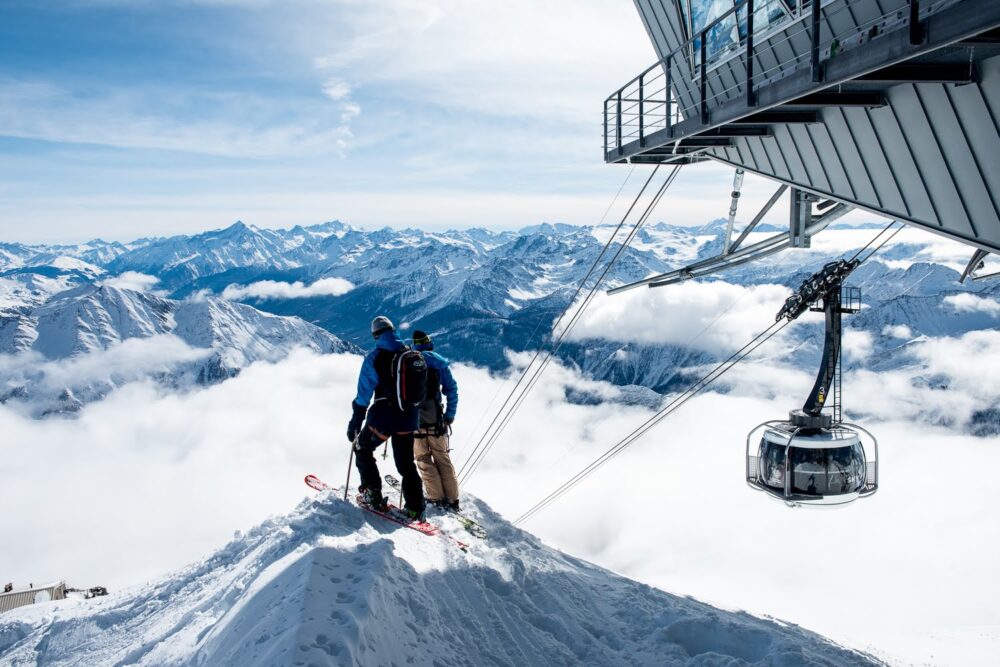
After a summer marked by glacier retreat, rockfalls, unstable permafrost and repeated disruption across the Alps, an increasingly difficult question is emerging: how should mountain tourism adapt to a rapidly changing environment?
The debate has been brought into sharper focus by Legambiente, one of Italy’s largest environmental organisations, which argues that Alpine communities can no longer plan their future on the assumption that glaciers, water resources and snow conditions will remain as they have been in the past.
Speaking to Corriere della Sera during the 2026 Carovana dei Ghiacciai, Vanda Bonardo, the campaign’s coordinator and national head of Legambiente’s Alps division, said mountain regions need to move from planning based on stability towards managing continuous change.
Her comments come during an extraordinary summer across the Alps, with developments around Mont Blanc providing some of the clearest examples.
From Planpincieux to the wider Mont Blanc massif
The rapidly retreating Planpincieux Glacier above Val Ferret has become one of the most visible examples of the transformation taking place around Mont Blanc.
Scientists monitoring the glacier have documented a dramatic loss of ice, while the wider massif has experienced an exceptional summer of rockfalls, unstable terrain and changes to traditional mountaineering routes.
But Planpincieux is only one part of a much larger picture.
During Legambiente’s latest visit to the Miage Glacier in Val Veny, Bonardo described dramatic changes since the organisation’s previous visit in 2020.
According to Bonardo, the glacier surface in one monitored area had already dropped around 15 metres over three decades when the organisation visited six years ago — and has since lost approximately another 15 metres in thickness.
Water availability is becoming another concern.
Bonardo pointed to difficulties affecting high-altitude refuges and pastures, including water shortages as springs and traditional water sources change.
These developments add another dimension to the discussion about climate change in the Alps: the issue is no longer simply how much ice is being lost, but how communities and tourism economies should adapt to the consequences.
Read more: Nepal Glacier Disaster: Could It Happen in the Alps? — A look at what the Nepal disaster can tell us about glacier retreat, permafrost degradation and the growing challenge of monitoring high-mountain hazards in a warming climate.
Does the ski economy need to change?
This is where Legambiente takes a considerably stronger position.
The environmental organisation argues that Alpine regions cannot continue with what Bonardo described as the traditional ski economy “as if nothing were happening”, particularly as water resources become increasingly uncertain.
Legambiente has long advocated diversification away from excessive dependence on skiing, particularly at lower and more climate-vulnerable elevations.
Its 2026 Nevediversa report counted 273 abandoned ski installations across the Italian Alps and Apennines and argued that a disproportionate share of public funding for mountain tourism continues to support snow-based infrastructure rather than diversification and redevelopment.
That does not necessarily mean that skiing has no future in the Alps.
Many high-altitude resorts continue to invest heavily in lifts, snowmaking, water storage, energy efficiency and four-season tourism, while skiing remains economically fundamental to numerous Alpine communities.
But the events of summer 2026 increasingly suggest that the debate may need to move beyond a simple choice between skiing and no skiing.
The more complicated question is where skiing remains viable, what infrastructure should continue to receive investment, and how resorts can build an economy that is less dependent on a predictable winter season.
Artificial snow — and the question of water
Snowmaking is inevitably part of that discussion.
Modern snowmaking has allowed resorts to provide far more reliable pistes during periods of limited natural snowfall, and in many destinations it has become essential to the operation of the winter tourism economy.
However, higher temperatures can reduce the periods during which snow can efficiently be produced, while changing water availability raises another question: how should increasingly valuable Alpine water resources be allocated?
The issue therefore varies enormously from one resort to another.
A high-altitude ski area with suitable temperatures, reservoirs and a strong tourism economy faces a very different future from a small, low-altitude ski station repeatedly dependent on artificial snow during increasingly marginal weather windows.
This distinction is likely to become increasingly important when governments and regional authorities decide where public money should be invested.
Protecting the land left behind by retreating glaciers
Legambiente is also calling for greater legal protection for glaciers and newly deglaciated terrain.
Through a European manifesto on glacier governance, the organisation wants these areas to be recognised as common assets and protected from uncontrolled development as the ice retreats.
Bonardo cited the controversial works carried out on the Theodul Glacier between Zermatt and Cervinia in preparation for the proposed World Cup races as an example of the difficulty of protecting glacial terrain under existing legislation.
The organisation ultimately wants the issue brought to Brussels and addressed through specific European rules governing glaciers and deglaciated areas.
From managing glaciers to managing change
Perhaps the most significant element of the current debate is that glacier retreat is increasingly being treated not simply as an environmental measurement but as a planning problem.
Roads, refuges, climbing routes, water supplies, ski infrastructure and entire tourism economies have developed around an Alpine environment that was assumed to be relatively stable.
That assumption is becoming harder to maintain.
The events around Mont Blanc this summer — from glacier retreat and rockfall to changes in climbing access and high-altitude infrastructure — provide a particularly visible example of that transition.
For ski resorts, this does not automatically mean the end of skiing.
It does mean that the industry may increasingly have to distinguish between locations where continued investment in skiing remains economically and climatically realistic and those where diversification is becoming unavoidable.
The Alps are changing.
The challenge now is not simply documenting that change, but deciding how mountain communities — and the ski industry that remains central to many of them — adapt to it.
Read More
- Planpincieux Glacier Retreat: Mont Blanc’s Changing Landscape in 2026
https://www.the-ski-guru.com/2026/08/25/planpincieux-glacier-retreat-mont-blanc-2026/ - Alps Heatwave and Glacier Closures: What Is Happening in the Mountains
https://www.the-ski-guru.com/2026/08/10/alps-heatwave-glacier-closures/ - 15,000m³ Rockfall at Aiguille du Midi as Extreme Heat Destabilises Mont Blanc
https://www.the-ski-guru.com/2026/08/15/aiguille-du-midi-rockfall-15000m3/ - Chamonix Introduces New Bivouac Rules in the Mont Blanc Massif
https://www.the-ski-guru.com/2026/08/15/chamonix-bivouac-rules/ - Zermatt-Cervinia Summer Skiing Closure
https://www.the-ski-guru.com/2026/07/31/zermatt-cervinia-summer-skiing-closure/ - Snow Conditions and a Warming Alpine Climate
https://www.the-ski-guru.com/2026/02/23/snow-conditions-warming-alpine-climate/
Sources
- Corriere della Sera Torino — Interview with Vanda Bonardo, Legambiente, 24 August 2026
https://torino.corriere.it/notizie/piemonte/26_agosto_24/ghiacciai-da-tutelare-va-ripensata-la-montagna-non-si-puo-proseguire-con-la-solita-economia-dello-sci-come-se-nulla-fosse-a1c70e4c-0721-490a-9534-b4b25ab18xlk.shtml - Legambiente — About the organisation
https://www.legambiente.it/chi-siamo/ - Legambiente — Nevediversa 2026
https://www.legambiente.it/comunicati-stampa/report-nevediversa-i-dati-sugli-impianti-dismessi-in-quota/
Planning your next trip to the Italian Alps?
If you’re heading to the Aosta Valley, take a look at Il Cuore della Valdigne, our family-owned apartment in Morgex, available for rent when we’re not using it ourselves.
It’s an ideal base to:
- Ski in Courmayeur, La Thuile and Pila
- Enjoy the mountains in summer (hiking, biking, nature)
- Explore the Mont Blanc valley in a quieter, more authentic setting.
Check my Mountain Art on my Shop
You can go to my shop and see what have been inspiring me lately, lots mountain landscapes in soft pastels, and now in oils too. Go here to check my latest works!

Featured Image: Photo credit: Skyway Monte Bianco.


Discover more from The-Ski-Guru
Subscribe to get the latest posts sent to your email.
 Subscribe to The-Ski-Guru here.
You must be logged in to post a comment.