

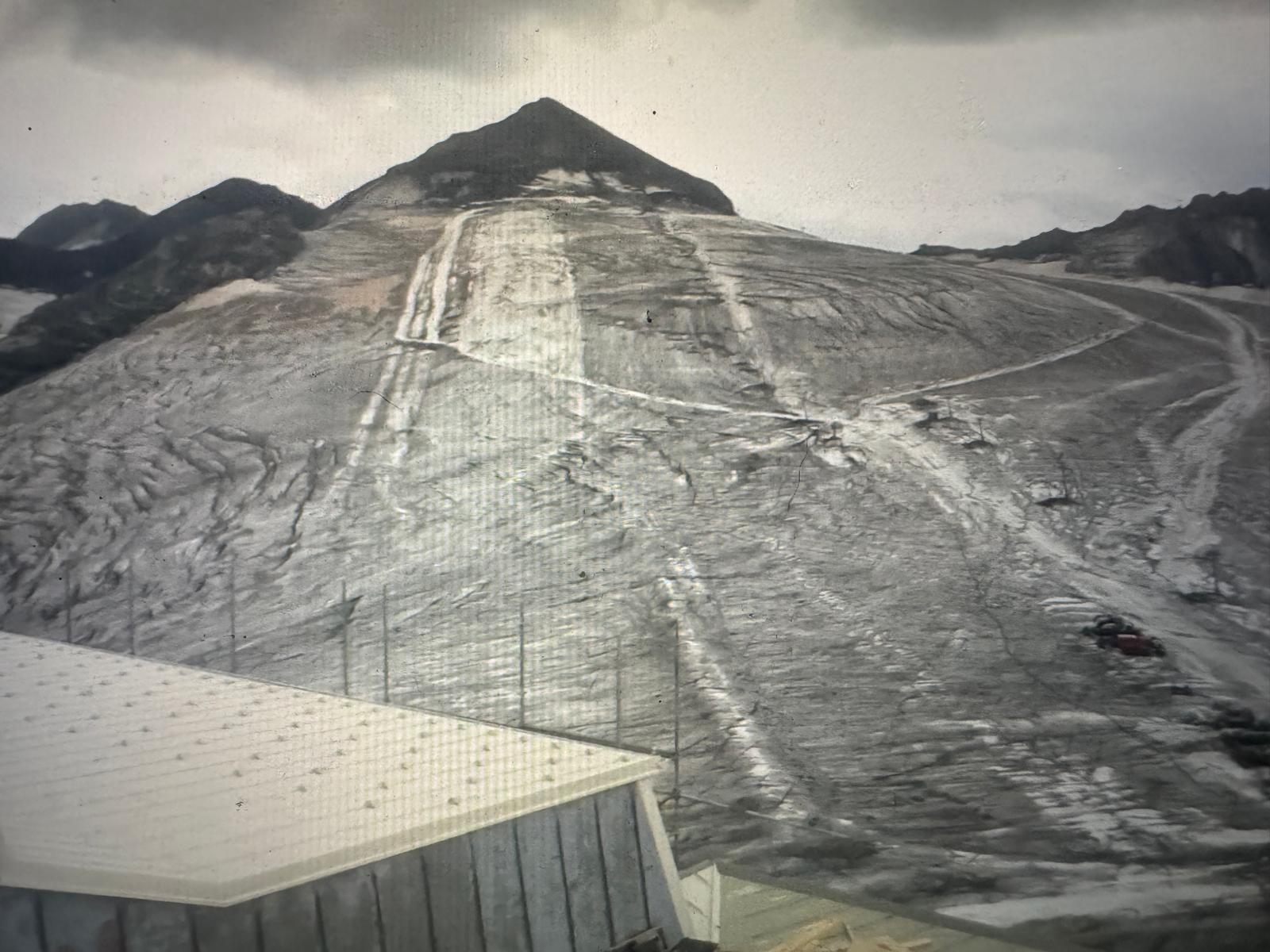
Summer glacier skiing has effectively disappeared from the Alps in mid-August after persistent extreme heat forced Passo Stelvio, the last Alpine glacier still offering lift-served summer skiing, to suspend operations.
Skiing on Italy’s Stelvio Glacier was suspended from 15 August until further notice, following weeks of unusually warm conditions at high altitude.
The closure completes a remarkable sequence across the Alps. Zermatt-Cervinia suspended public summer skiing at the beginning of August, while Saas-Fee followed on 10 August. In France, the summer skiing period at Les 2 Alpes had already ended in early July.
For an activity that was once a familiar part of the Alpine summer, the situation in August 2026 is striking: there is currently nowhere left in the Alps offering conventional lift-served summer glacier skiing.
Passo Stelvio: Heat and Lack of Overnight Freezing
Passo Stelvio had become the final holdout.
SIFAS, the company operating the Stelvio summer ski area, announced that skiing would be suspended from 15 August because conditions could no longer guarantee safe operations.
The operator pointed to persistent heat at high altitude, insufficient overnight cooling and refreezing, and storms that had further affected conditions on the glacier.
The decision was described by the operator as necessary to protect the safety of skiers and staff.
Unlike most Alpine glacier ski areas, Stelvio is unusual because skiing is traditionally a summer rather than winter operation. Its high-altitude glacier has for decades been an important training ground for ski racers and national teams during the European off-season.
The suspension therefore represents more than the temporary loss of another summer ski area: Stelvio was the last major Alpine option still operating as the August heat continued.
Saas-Fee Closed Days Earlier
The Stelvio announcement came only days after another of the Alps’ major summer ski centres was forced to stop.
Saas-Fee suspended summer skiing from 10 August because of persistently high temperatures and deteriorating snow and glacier conditions.
Despite intensive maintenance work, conditions had deteriorated to the point where the required quality and safety of the pistes and glacier infrastructure could no longer be guaranteed.
The interruption is particularly significant because Saas-Fee’s published summer and autumn programme had envisaged skiing continuing through August and then into its autumn training season.
In other words, this was not simply the scheduled end of a short summer season. Operations stopped earlier than planned because conditions on the glacier had changed.
Zermatt-Cervinia Was an Early Warning
The deterioration had already become evident around the Matterhorn.
Summer skiing between Zermatt and Cervinia was suspended at the beginning of August after exceptionally warm conditions affected the Theodul Glacier.
The high-altitude glacier ski area around the Matterhorn has traditionally been one of Europe’s most important summer skiing destinations, reaching elevations of around 3,500 metres.
That makes the closure particularly significant: even some of the highest lift-accessed ski terrain in the Alps has been affected by this summer’s prolonged heat.
The-Ski-Guru reported the Zermatt-Cervinia suspension when it was announced at the end of July.
France Had Already Finished Its Summer Skiing
France no longer provides an August alternative either.
Les 2 Alpes, traditionally one of Europe’s best-known summer glacier skiing destinations, now concentrates its summer skiing primarily around late spring and early summer, particularly for ski racers, professional athletes and training groups.
Its 2026 summer skiing period had already finished by early July.
The days when several French glaciers routinely provided recreational skiing deep into July and August have gradually disappeared.
Tignes, once another major name in European summer skiing, has also dramatically reduced its summer glacier operations in recent years.
What About Austria?
Austria might seem the obvious exception, particularly because Hintertux has long been associated with year-round glacier skiing.
However, the traditional model of skiing throughout the entire Alpine summer has changed there too.
Austria’s glacier areas increasingly concentrate their ski operations around the autumn, winter and spring seasons, while high-altitude lifts and glacier attractions can continue operating for summer visitors.
That means Austria does not currently provide an alternative for conventional lift-served August glacier skiing.
A Bigger Story Than One Closed Ski Area
The significance of the Stelvio closure therefore extends beyond a single Italian glacier.
Over the course of only a few weeks, summer skiing has stopped at the remaining high-altitude areas that were still operating during the hottest part of the Alpine summer.
The common problem is not simply daytime temperature.
Glacier ski areas depend heavily on cold nights. Overnight freezing helps stabilise the snow surface and allows piste teams to prepare terrain before skiers arrive early in the morning.
When temperatures remain high overnight, that cycle breaks down.
Snow becomes increasingly difficult to maintain, exposed glacier ice deteriorates more quickly, and crevasses and other hazards can become harder to manage.
The Heat Is Affecting Much More Than Skiing
The consequences of the prolonged heat have extended far beyond ski slopes.
Across the Alps, authorities, mountain guides and refuge operators have been dealing with deteriorating glacier conditions, rockfall, unstable high-mountain terrain and changes to mountaineering routes.
On the Bernina massif, the Marco e Rosa refuge — at 3,609 metres — closed on 6 August because deteriorating conditions on the glacier approaches made access increasingly unsafe.
Importantly, the refuge itself was not reported to be structurally unstable.
The problem was the route to reach it.
High temperatures had affected snow cover and the glacier approaches, with widening crevasses and increasingly unreliable snow bridges creating dangerous conditions for mountaineers.
The refuge announced the closure until further notice, another example of how this summer’s conditions are changing not only where people can ski, but how safely they can travel through the high mountains.
Similar problems have emerged elsewhere across the Alps, while rockfalls and route restrictions have highlighted the effects of prolonged heat on high-altitude terrain.
Is Summer Glacier Skiing Disappearing?
One exceptionally hot summer does not mean that skiing will never return to these glaciers.
Stelvio, Saas-Fee and Zermatt have treated the interruptions as weather and conditions-related suspensions rather than permanent closures, and colder conditions could allow skiing to resume.
But the longer-term direction is increasingly difficult to ignore.
European summer skiing has already contracted dramatically compared with previous decades. Resorts that once operated through much of July and August have shortened their seasons, shifted skiing towards spring or autumn, restricted access primarily to race training, or abandoned summer skiing altogether.
August 2026 provides a particularly stark illustration of that transformation.
Within the space of a few weeks, even some of the highest and most established summer glacier ski areas in Europe have been unable to continue operating.
For the moment, at least, the traditional image of taking a cable car into the high Alps and skiing on a glacier in the middle of August has disappeared.
And Passo Stelvio — the last major Alpine area still offering it this summer — has now been forced to stop.
Read More
Zermatt-Cervinia Summer Skiing Suspended as Heat Hits the Theodul Glacier
https://www.the-ski-guru.com/2026/07/31/zermatt-cervinia-summer-skiing-closure/
Alps Heatwave: Glacier Closures and High-Mountain Disruption
https://www.the-ski-guru.com/2026/08/10/alps-heatwave-glacier-closures/
15,000m³ Rockfall at Aiguille du Midi as Extreme Heat Destabilises Mont Blanc
https://www.the-ski-guru.com/2026/08/15/aiguille-du-midi-rockfall-15000m3/
Chamonix Tightens Bivouac Rules as High-Mountain Conditions Change
https://www.the-ski-guru.com/2026/08/15/chamonix-bivouac-rules/
Sources
Passo Stelvio / SIFAS – Official information
https://passostelvio.eu/en/home-eng/
Saas-Fee – Official summer skiing information
https://www.saas-fee.ch/en/summer-activities/summer-ski/training-possibilities-for-teams
Saas-Fee – Official lift and summer/autumn timetable
https://www.saas-fee.ch/en/services-informationen/prices-timetables-cable-cars/timetables-cable-cars/timetables-cable-cars/summer/saas-fee-timetables-summer-autumn
Zermatt Bergbahnen – Official summer skiing information
https://www.matterhornparadise.ch/en/experience/skiing/summer-ski
Cervino Ski Paradise – Official website
https://www.cervinia.it/
Les 2 Alpes – Official summer information
https://www.les2alpes.com/summer/
Hintertux Glacier – Official skiing information
https://www.hintertuxergletscher.at/en/skiing/hintertux-glacier/ski-snowboard/
Planning your next trip to the Italian Alps?
If you’re heading to the Aosta Valley, take a look at Il Cuore della Valdigne, our family-owned apartment in Morgex, available for rent when we’re not using it ourselves.
It’s an ideal base to:
- Ski in Courmayeur, La Thuile and Pila
- Enjoy the mountains in summer (hiking, biking, nature)
- Explore the Mont Blanc valley in a quieter, more authentic setting.
Check my Mountain Art on my Shop
You can go to my shop and see what have been inspiring me lately, lots mountain landscapes in soft pastels, and now in oils too. Go here to check my latest works!
Featured Image: Passo dello Stelvio today 16th August. Webcam Passo dello Stelvio.


Discover more from The-Ski-Guru
Subscribe to get the latest posts sent to your email.
 Subscribe to The-Ski-Guru here.